
You have $1,500 saved and a full-time job you want to leave. Nine tabs are open in your browser, each a different program promising to make you a “Certified Wedding Planner” in twelve weeks. The pitch never changes: get the badge, get the clients. What you actually need to know is simpler. Does the badge do anything a booked wedding on your portfolio wouldn’t do faster and cheaper?
Wedding planner certification is worth it for some people and a waste of money for others. The difference has almost nothing to do with the program. It comes down to where you are right now, what you already know, and who you’re trying to convince. Let me walk through what these certifications really are, what they cost in 2026, and when the money is better spent elsewhere.
What a wedding planner certification actually gets you
There is no license to plan weddings. Unlike a real estate agent or a cosmetologist, you don’t need a government credential to legally run someone’s wedding day. Every “certification” you’ll find is issued by a private company or a trade association, and each sets its own bar. That matters, because the word “certified” carries a weight it hasn’t earned. A couple hears it and assumes a licensing board vetted you. No board exists.
What you’re really buying is three things in one bundle: a structured curriculum, a piece of paper with a logo, and, in the better programs, a network. The curriculum has real value if you’re starting cold. A good course walks you through building a timeline, reading a catering contract, running a rehearsal, and pricing your own services. It should also teach you to handle a difficult mother-of-the-bride without losing the room. The logo is marketing, plain and simple. The network is where working planners get their money’s worth. Referrals from other planners who are double-booked are one of the most reliable client sources in this business.

Here’s the honest split. If you already have five weddings under your belt as a second shooter or an assistant, the curriculum teaches you little you don’t know. If you’ve never held a clipboard on a wedding day, it can save you from learning basic mistakes in front of a paying client. Be honest about which one you are.
What the main programs cost in 2026
Wedding planner certification prices run from a few hundred dollars to over five thousand. Price doesn’t track with quality in a clean line, so shop with your eyes open. Here’s the realistic landscape.
The Association of Bridal Consultants runs a membership model. Expect roughly $300 to $350 a year in dues. Its professional designations are earned over time, through coursework and documented weddings, rather than in a single course. This is the slow, credential-stacking route, and it suits planners who want a title that reflects real experience.
Online programs like Lovegevity’s Wedding Planning Institute and QC Event School sit in the $1,000 to $2,000 range. Most offer payment plans that break the cost into monthly installments of $150 to $300. They’re self-paced, heavy on video and workbooks, and they hand you a certificate at the end. The American Association of Certified Wedding Planners runs an in-person bootcamp instead. That one lands between $3,000 and $5,000 depending on your city, and the draw is the intensity plus a local chapter network.
Watch the initials, too. You’ll see “CWP,” “PWP,” “ABC-accredited,” and a dozen more, and none of them mean the same thing. A designation you earned after documenting fifteen real weddings is worth more than a certificate printed the day you finished a video series, even if both look identical in an email signature.
Now add the costs the sales page skips:
- Business insurance: $400 to $700 a year for the general liability most venues now require before they’ll let you work.
- LLC filing: $50 to $500, depending on your state.
- Website, CRM, and planning software: another $50 to $150 a month.
The certificate is often the smallest line item in starting a wedding planning business. Leading with it, and skipping the rest, is exactly how new planners get caught short.
Do couples actually care about certification?
This is the question that decides everything. The honest answer: less than the programs want you to believe, but more than zero.
In six years of asking couples why they booked one planner over another, I’ve almost never heard “because she was certified.” What I hear instead is that she answered fast, her portfolio matched their vibe, another vendor recommended her, and she felt calm on the phone. Certification made none of those lists. It lines up with what the wider industry tells couples, too. The Knot’s guidance on hiring a planner leads with reviews, referrals, and portfolio fit, not credentials. Couples hiring a full-service planner for a $60,000 wedding are buying trust and taste. They read that off your work and your references, not a logo in your email signature.
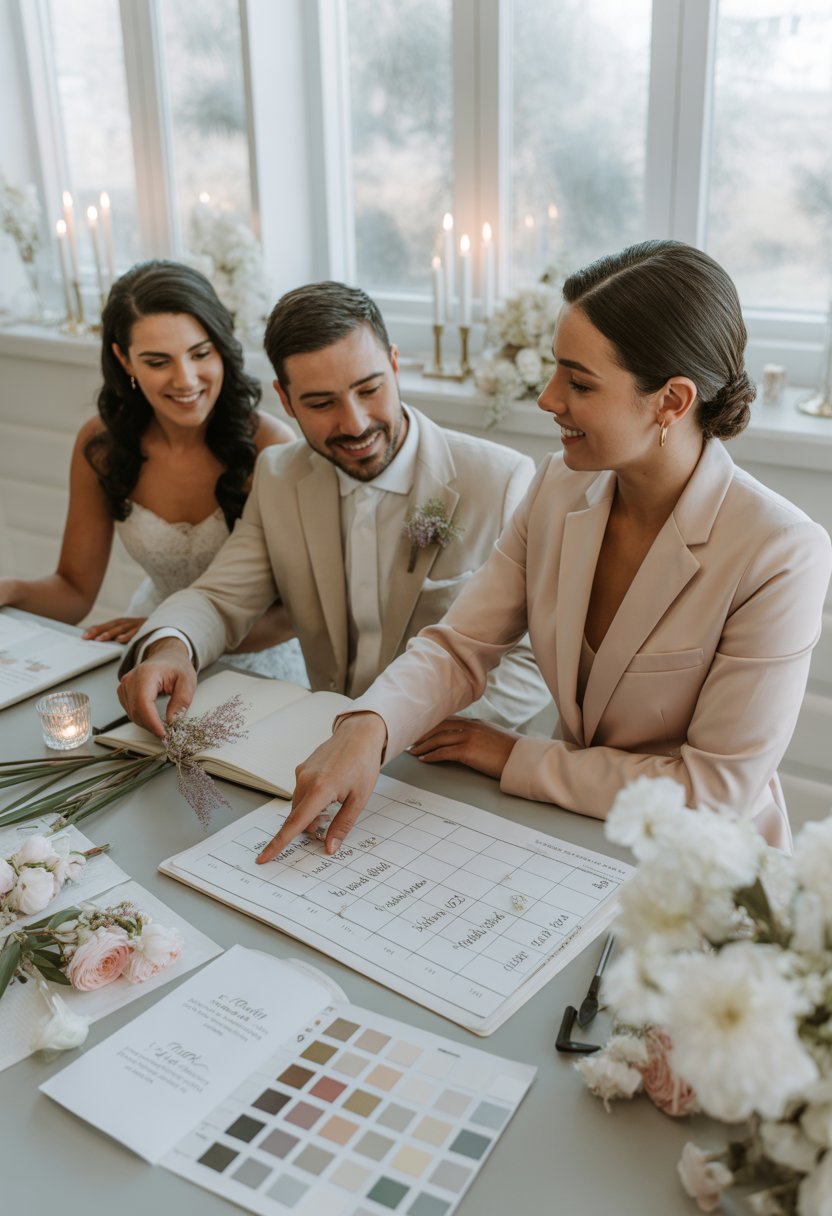
There are two spots where the certificate does pull weight. The first is the very start, when you have no portfolio at all. A couple comparing two brand-new planners with empty Instagram grids might tilt toward the one who completed a 150-hour program. It’s a tiebreaker for the unproven, not a selling point for the established. The second is your own confidence. I once watched a certified planner and an uncertified one pitch the same couple for a barn wedding in Vermont. The couple picked the uncertified one. She’d worked two weddings at that exact venue and knew where the light died at 6 p.m. Experience read as competence in a way no logo could.
What certification does not teach you
Every program covers timelines and vendor coordination. Almost none teach the two things that actually decide whether your business survives: pricing and sales.
Most curricula give pricing one module, a bland overview of flat fees versus percentages, then move on. They won’t warn you that a day-of coordinator charging $800 in a market that supports $2,200 is the top reason new planners quit inside two years. They won’t teach you to hold your price when a couple pushes back. They won’t show you a deposit schedule that protects your cash flow, something like 40% at signing, 40% at ninety days out, and the balance two weeks before the date. And they rarely cover how to write a cancellation clause that keeps a 2026 postponement from wiping out a season’s income. Those are the skills that pay your rent.
Sales is the bigger gap. The consultation call, where a couple decides to hire you, is a skill you can practice and sharpen. No wedding certification I’ve seen teaches it well. You learn it by taking twenty calls, losing the first ten, and figuring out why. A certificate can’t shortcut that. Nor can it build the local vendor relationships that feed you repeat referrals. The florists, photographers, and venue managers who send you three couples a year do it because you made their job easier on a wedding you shared. That trust is earned on-site, one clean load-out at a time.
When certification is worth it, and when it isn’t
Spend the money under three conditions. You’re career-changing into weddings with zero events background. You learn better with structure than by trial and error. And the program you’re eyeing has an active local network you can verify by talking to two graduates. Meet all three, and a $1,500 course can compress a year of fumbling into a few months. It can also give you the nerve to charge properly from your first booking. That’s a real return.
Skip it, or at least defer it, if any of these fit. You’ve already assisted on several weddings and know a real timeline from a fantasy one. You’re tight on startup cash and choosing between a certificate and business insurance. Insurance wins that one every time, because venues will turn you away without it and never once ask about a certificate. Or you’re being sold a certification whose headline promise is “clients included,” which is almost always a lead-list of tire-kickers, not real bookings.

Here’s the test I give people who ask me directly. If that $1,500 could instead go toward assisting an established planner for a season, even unpaid or barely paid, take the apprenticeship. Ten real weddings beside someone who knows the job will teach you more than any course. You’ll finish with references, photos, and a mentor who sends you overflow work. Certification is a fine supplement to that. It’s a poor substitute for it.
Cheaper ways to build the credibility couples actually check
Before you pay for a badge, put the same energy into what couples read first. A portfolio of three real weddings beats any certificate. You can build one by second-shooting or assisting through a single season. Even styled shoots work: arrange one with a photographer and a few vendors trading time, and you walk away with images that prove you can pull a look together. Couples scroll your work, so make sure there’s work to scroll.
Reviews are the other currency. Five specific, recent reviews from real couples will out-convert any credential on your profile. Ask for them the week after the wedding, while the relief and gratitude are still fresh. Ask for specifics, not a generic star rating. Try something like, “Would you mind writing a couple of lines about how the timeline held up on the day?” You’ll get a far better review than a vague “please leave feedback” ever pulls. It also helps to be where couples are already searching. A profile on a platform built to connect planners with couples who are actively hiring puts your work in front of buyers ready to book. A certificate on your own quiet website never does that.
The rest is reputation, built in person. Show up early. Solve problems the couple never sees. Tip the catering crew, and be the vendor other vendors want to work beside. That reputation compounds. A certificate doesn’t, because it’s a one-time signal that stops paying you the day after you earn it. A strong vendor network and a wall of reviews pay you every season.
So, is wedding planner certification worth it?
For a true beginner who needs structure and nerve, a mid-priced wedding planner certification can be a reasonable first investment. The condition is that it comes with a real network, and that you treat it as a starting line, not a finish.
For anyone with even a little on-the-ground experience, the math changes. The same money almost always does more spent on insurance, a portfolio, and getting your work in front of couples who are hiring. Look at your own bank of experience honestly. Price out the alternatives. Then check our pricing and listing options before you assume the certificate is the one thing standing between you and your first booked wedding. It usually isn’t.
So here’s the assignment. This week, message two planners in your area whose work you admire and ask if they need a paid assistant for the season. That single email will tell you more about whether you need a course than any sales page ever will.