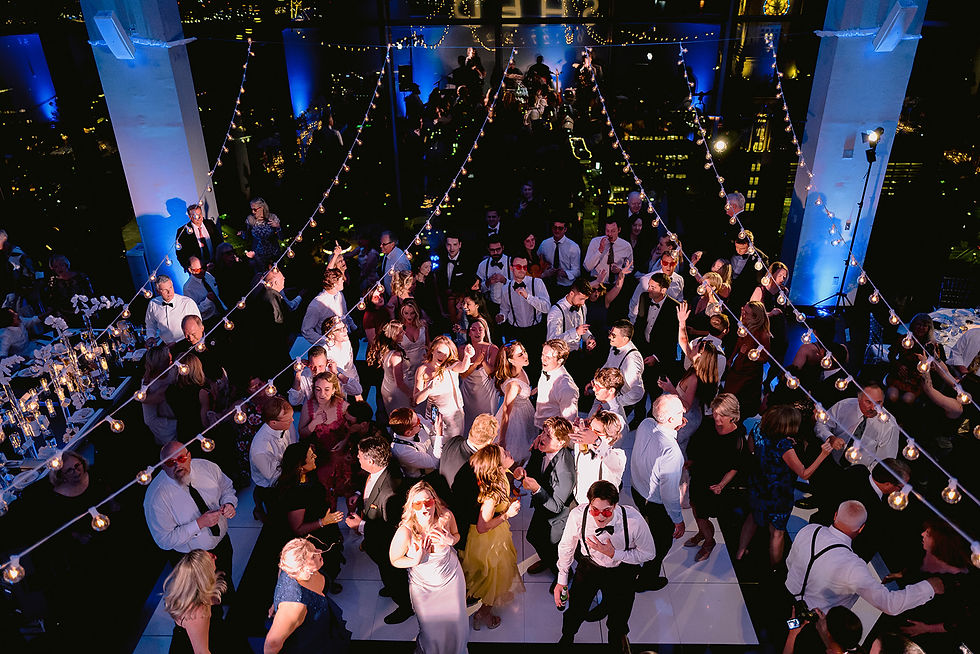
The band’s contract says the last song ends at 10:00 p.m. It’s 9:52. The dance floor is finally full, and someone’s uncle is standing at the edge of the stage, asking the bandleader what it would take to keep playing. That question has a price. At a 130-guest reception in 2026, the answer usually lands between $900 and $3,600, once every vendor who has to stay adds a line to the invoice.
Wedding overtime fees are the least-planned number at most weddings. Couples budget carefully for the florist’s 50% deposit and the caterer’s final-count deadline. Then a $2,700 charge shows up three weeks after the honeymoon, because dinner service started 25 minutes late and the night never caught up. The clauses that trigger those charges sit on page four of a contract nobody reread after signing. Most of that cost is preventable. The decisions that prevent it happen around 6:00 p.m., not at 9:52.
What Wedding Overtime Fees Cost in 2026, Vendor by Vendor
Venue overtime is the largest single number and the least flexible. Hotel ballrooms and downtown event spaces in major metros charge $1,000 to $2,500 per hour. They bill in full-hour blocks, whether you use twelve minutes of it or fifty-five. Barns, vineyards, and private estates usually sit between $500 and $1,200 per hour. Plenty of venues will not sell you the extra time at any price, which is a separate problem worth understanding before you plan around it.
Here is what wedding overtime fees look like across the rest of the vendor team in 2026:
- Catering: $35 to $65 per staff member per hour. A 130-guest plated dinner runs 14 to 18 people on site.
- Live band: $75 to $150 per musician per 30-minute block, so an eight-piece band is $1,200 to $2,400 for the hour.
- DJ: $150 to $400 per hour, often in half-hour increments.
- Photography: $350 to $750 per hour, plus $100 to $200 for the second shooter.
- Video: $300 to $600 per hour per operator.
- Planning team: $75 to $200 per person per hour, billed for everyone still on site.
- Shuttles and motorcoaches: $95 to $185 per bus per hour, with a one-hour minimum.
Catering overtime is billed as labor, not as a flat fee. One extra hour of service on that 130-guest dinner costs $600 to $1,000 before anyone extends the bar. Ask whether your caterer bills in 30-minute increments. Many do, and that one question can cut your exposure in half.
Live music has a deadline attached to the money. Bandleaders need your answer at the last set break, usually around 9:15, because the sound company’s load-out crew is already scheduled and the truck is already booked. A DJ is the cheapest overtime at any wedding, and some will waive the last fifteen minutes. Photo and video give no partial credit at all. Fifty minutes past the end time bills as a full hour.
Transportation is the line everyone forgets. Drivers hit federal limits that no amount of money extends. The FMCSA hours-of-service rules cap a passenger-carrying driver at 10 hours of driving after 8 consecutive hours off duty. When the shuttle driver is out of hours, 60 guests are ordering rideshares from a vineyard with two bars of signal. I have watched that happen twice, and both times it cost more in goodwill than in dollars.
Add up a realistic 45-minute overrun at that same 130-guest wedding. The venue bills a full hour at $1,200. Catering labor adds $650. The band charges two half-hour blocks, $900. The photographer is $450, the coordinator $150. That is $3,350 in wedding overtime fees for less than an hour of dancing, and none of it was in the budget spreadsheet.

Why Receptions Run Late (It Is Almost Never the Dance Floor)
Hair and makeup is the most common cause of a late wedding. The deficit exists hours before anyone notices it. One artist doing a bride plus six attendants needs about 45 minutes for the bride. Everyone else takes 30 to 35 minutes each. That is four and a half hours of chair time. The schedule usually allots three, because the quote said “bridal party of six.” So the ceremony starts 20 minutes late, and nothing downstream compresses on its own.
Family photos come next. A list of 22 groupings at three to four minutes each is 70 to 90 minutes of shooting. The list always grows on the day, because an aunt asks for one more. Toasts are the other reliable culprit. Couples budget three minutes per speaker. The real average is closer to seven. Four speakers who each run long push dinner back 20 minutes, for a kitchen that plates on a fixed schedule.
Buffets eat time quietly. A double-sided buffet feeds 130 guests in roughly 45 to 55 minutes, if a coordinator releases tables in sequence. Single-sided, it is closer to 90. Then there is golden hour. Your photographer wants twelve minutes outside at 7:10 p.m. in September. That falls in the middle of the entree course. Each of these is small on its own. Stacked, they become the 45 minutes of wedding overtime fees you pay for at midnight.
The Overtime You Cannot Buy: Hard Outs and Noise Ordinances
Some end times are not a pricing question at all. Municipal noise ordinances in residential-adjacent zones commonly cut amplified sound at 10:00 p.m. on weeknights and 11:00 p.m. on Saturdays. First-offense citations run $250 to $2,000. The bigger problem is the complaint record, which threatens the venue’s special-event permit for every couple who books after you. Beach and park permits are stricter, often 9:00 or 10:00 p.m., with a ranger physically present. Historic properties frequently carry insurance riders that void coverage past a stated hour.
Union labor is the other hard wall. Hotel banquet contracts in Chicago, New York, and San Francisco push staff into overtime or double-time after eight hours. The venue passes that through at a multiple, not at cost. Maybe the property has a Sunday brunch, or a Saturday morning conference load-in. Then your rentals genuinely have to be off the floor by 1:00 a.m. The strike crew’s clock started when yours did. In these situations wedding overtime fees are not the risk. The citation is, along with a sound system that goes silent mid-song.
Ask this at the site visit, in these words: what time does amplified sound have to stop, who enforces it, and what happened the last time a wedding ran past it? A venue manager who answers precisely is telling you the rule is real. One who shrugs is telling you the fine lands on your credit card. Get that answer written into the contract. An email from a sales coordinator is worthless in ten months, once that person has moved to another property.

How to Read the Overtime Clause Before You Sign
Six details decide what wedding overtime fees actually cost you. Read for each one before you sign, because none of them move afterward:
- The increment. Per hour, per 30 minutes, or per 15, and whether partial time rounds up.
- The notice window. How far ahead you have to commit, which is often a full 60 minutes at a hotel.
- Who can authorize it. A well-meaning parent should not be able to spend $1,500 of your money at 9:58.
- A rate stated in dollars. Never “then-current rates” or “prevailing labor rates.”
- A written cap. Two increments maximum is a reasonable ask and a common yes.
- Event end versus load-out complete. Two separate deadlines, two separate penalties.
Compare two real clause structures. The first: event must conclude by 10:00 p.m.; additional time billed at $1,500 per hour or any portion thereof, charged to the card on file. The second: additional time billed at $375 per 15-minute increment, maximum two increments, authorized in writing by Client or Client’s designated representative. Same venue, same night. A 20-minute overrun costs $1,500 under the first clause and $750 under the second.
Ask for the first 30 minutes at half rate, then push for 15-minute increments and a stated ceiling. My honest read after years of contract review: most venues will move on the increment. Almost none will move on the rate. Spend your negotiating capital accordingly. A full-service wedding planner reads these clauses across all 12 to 15 of your contracts at once. The band, the venue, and the shuttle then work from one end time, not three.
What a Coordinator Does at 8:15 p.m. to Keep You Out of Overtime
Good coordination is mostly arithmetic done backwards. Start from the hard out. Subtract load-out, the last dance, the cake cutting, the parent dances. What is left is the real latest start for dinner. Anything that has to happen after that time gets cut or moved before the wedding day. Nobody improvises well at 9:40, when everyone is emotional and no one wants to be the person who says no.
The working habit is checkpoints. A coordinator who is 10 minutes behind at 6:15 does not let it become 30 minutes behind at 8:15. They shorten the second course’s service window, or turn sunset photos into a five-minute grab. They cut the toast block from four speakers to two and move the other two to the rehearsal dinner. A good one also builds a genuine 15-minute float into the timeline instead of a fantasy one. Most importantly, they know which vendor’s clock is the expensive one, and they protect that clock first.
The other job is the authorization conversation, and it belongs at the final walkthrough. Someone other than the couple should hold that decision. A parent, a sibling, or the planner working to a pre-approved dollar cap. Booking day-of coordination runs $1,800 to $3,500. It pays for itself the first time it keeps wedding overtime fees off the venue and catering invoices. That is the real argument for hiring a coordinator at a wedding that otherwise looks simple. Couples who skip it on a 130-guest reception are the ones calling me in October about a surprise invoice.
When Paying Wedding Overtime Fees Is the Right Call
Wedding overtime fees are not automatically a planning failure. Sometimes the extra 30 minutes is the best money spent all night. Price it per participating guest. Say 80 people are on the dance floor, and another 30 minutes of band plus venue costs $900. That is $11 a head, for the part of the night guests actually describe later. Set that against $900 spent upgrading to chiavari chairs. Nobody has ever gone home talking about the chairs.
The reverse case is just as clear. Keeping a photographer until 11:00 p.m. at $600 an hour to document a thinning crowd rarely produces images anyone prints. Stage a sparkler exit at 9:15, while the full guest list is still there. Release the photo team at 9:30 and let the party run on without a camera. Extending the bar is usually the wrong buy at hour six. Consumption per guest has dropped by then; your liability has not.
At the higher end, this gets formalized. Planners running $150,000-plus events routinely build a pre-approved overtime allowance into the budget. It is usually one hour across the music, venue, and coordination lines. The decision is made and funded before anyone gets emotional at 9:52. If you are working with a luxury wedding planner, ask whether that allowance already sits in your budget document. If it does not, that money is new spending on the night. The answer tells you a great deal about how the rest of the budget was built.
How to Budget for Overtime Before the Wedding
Carry a contingency line of 3% to 5% of your total budget. Label part of it for wedding overtime fees specifically. Left unlabeled, it gets absorbed by a linen upgrade in month seven. The Knot’s Real Weddings Study has put the national average in the low $30,000s in recent years. A 130-guest wedding in a major metro lands closer to $58,000. On that number, your contingency is $1,700 to $2,900. That covers a normal 30 to 45 minute overrun without touching anything else. Whatever you do not spend comes back to you.
Build a one-page rate sheet during contract review. Vendor name, contracted end time, overtime rate, increment, notice required, who can authorize. Most couples find at least one problem doing this. Two vendors have mismatched end times, or the shuttle’s last run leaves before the band stops. Sometimes a contract charges overtime straight to the card on file, with no approval step at all. Fix those in writing before your final payments go out. Vendor leverage disappears the day the balance clears.
Then name your authorizer out loud, and tell every vendor who it is. Still comparing planners? How the directory works walks through what coordination coverage includes and what to ask before you book. The planner pricing guide is worth reading at the same time. The coordination fee and the overtime you avoid are the same conversation in two columns.

Pull your venue, catering, music, photography, and transportation contracts into one document this week. Write the overtime rate and the notice window next to each vendor name. Some will say then-current rates, leave the increment blank, or authorize charges without your sign-off. Email those vendors today and ask for a number in writing. Wedding overtime fees are only a surprise when nobody has done that arithmetic in advance.