
You get two quotes for the same date. One is a woman who has planned 40 weddings herself, charging $4,800 for full-service planning. The other is a firm with a logo, a team page, and a proposal that lists five staff members, quoting $9,500. Same wedding, nearly double the price, and the couple staring at both has no idea what the extra money actually buys. That gap is the whole question in the solo wedding planner vs agency decision, and the answer is not “you get what you pay for.” Sometimes it is. Sometimes you are paying for a brand and a project manager who has never seen your venue.
What You’re Actually Choosing Between
A solo planner is one person who owns the business, takes your calls, builds your timeline, and usually runs your wedding day with one or two assistants she hires per event. She might do 15 to 25 weddings a year. When you hire her, you hire her, not a company that might reassign you.
An agency is a company with multiple planners on payroll or contract, a lead planner or founder who often books the client, and a team that executes. Some agencies do 80 to 150 weddings a year across their roster. The founder you met in the sales meeting may or may not be the person who runs your day. That single fact is the most important thing to pin down before you sign anything.
There is a middle category worth naming: the solo planner with a small staff of regular assistants. She is still the decision-maker on every wedding, but she has three or four people she trusts to staff a 200-guest event. On paper she looks solo. In practice she scales. That hybrid is often the sweet spot, and it rarely markets itself as clearly as either extreme.

The reason this matters is continuity. With a solo planner, the person who learns your family dynamics in month one is the same person handling your mother-in-law at the ceremony in month twelve. With an agency, that knowledge has to transfer between people, and transfers leak.
Solo Wedding Planner vs Agency: The Core Tradeoff
Price is where the two diverge first and hardest. A solo full-service planner in a mid-size US market typically runs $3,500 to $7,500, or 10 to 15 percent of a total budget if she charges by percentage, which lines up with national wedding planner cost surveys. An established agency in the same market usually starts at $8,000 and climbs past $20,000 for a large or logistically heavy wedding. In a major metro, agency full-service can open at $15,000 and luxury firms quote $40,000 and up before you have booked a single vendor.
What drives the agency premium is overhead you do not see: salaried staff, office space, insurance across a team, marketing spend, and the founder’s time spread thinner. Some of that overhead buys you real capacity. Some of it buys you a nicer proposal deck. Your job is to figure out which.
The tradeoff is not just money. A solo planner gives you a single, consistent point of contact and usually more of her personal attention per wedding, because she is taking fewer of them. The risk is capacity: she is one human, and one human gets the flu, has a family emergency, or double-books a consultation. An agency spreads that risk across bodies, but it dilutes the personal thread that made you trust the person in the first place. To compare fairly, look at how full-service planning is scoped in each package, not just the headline number.
Run the math on your actual budget before you react to the sticker. A solo planner at $5,000 on a $50,000 wedding is 10 percent. An agency at $12,000 on the same wedding is 24 percent, which is a lot of your budget to hand to coordination when it could go toward the guest experience. On a $200,000 wedding with 12 vendors and a two-day itinerary, the agency’s $18,000 might be the cheapest insurance you buy all year.
Who Actually Shows Up on Your Wedding Day
Here is the question that separates couples who are happy from couples who feel bait-and-switched: who runs the wedding. In the solo wedding planner vs agency debate, this is the single detail that predicts your happiness. Get the name in writing.
Solo planners are simple. She sold you, she plans you, she is there at 7 a.m. when the rentals arrive and at midnight when the last uncle gets poured into an Uber. Her only variable is her assistants, and you should ask how many she brings for your guest count. A rough industry ratio is one coordinator per 75 to 100 guests for a smooth event. A solo planner running a 250-person wedding with only one assistant is understaffed, and you will feel it during dinner service and the exit.
Agencies are where the surprises live. Many use a model where the founder or a senior planner books the client, then hands the day to a “lead coordinator” you meet six weeks out, if at all. That is not automatically bad. Some agency leads are sharper than the founder. But you deserve to know before you sign, not to discover at the rehearsal that the person you bonded with is at another wedding across town.

Ask three direct questions. Will the person in this meeting be on site my wedding day? How many staff will be present, and what is each one doing? If my assigned planner gets sick the week of, who covers, and have they seen my file? An agency that answers cleanly is worth its premium. One that gets vague is selling you a brand and staffing you with whoever is free.
What a Solo Planner Does Better
Attention is the honest advantage. A planner taking 18 weddings a year can hold your details in her head in a way a coordinator juggling 40 cannot. When you text her about a seating chart problem at 9 p.m. on a Tuesday, she knows exactly who Aunt Carol is and why she cannot sit near the bar. That memory is not a small thing over a twelve-month engagement.
Solo planners also tend to be more flexible on scope. Want to add a welcome dinner, drop the design piece because your venue is already stunning, or shift to a payment plan because a bonus landed late? A solo owner can say yes on the spot. An agency has policies, and policies exist to protect the company’s margin across many clients, not to bend for yours.
The personal relationship shows up in vendor referrals too. A good solo planner has spent years building trust with a tight circle of florists, photographers, and caterers she genuinely rates, and she stakes her reputation on each referral because it is hers alone. She is not steering you toward a preferred-vendor list negotiated at the company level. That matters most when your budget is tight and every dollar of a referral has to earn its place.
The cost of all this closeness is fragility. One person has one calendar, one immune system, one car that can break down on I-95 on the wedding morning. A serious solo planner mitigates this with a written backup plan and a peer she can call. Ask for it. If she has no answer for “what happens if you cannot make it,” that is a real gap, not a hypothetical.
Where an Agency Earns Its Higher Fee
Scale and redundancy are the agency’s genuine product. A 300-guest wedding with a ceremony flip, two bands, valet, a shuttle schedule, and 14 vendors is a logistics operation, and a team with defined roles executes that better than one person and a hired assistant ever will. If your wedding has moving parts measured in the dozens, the agency premium starts looking like a fair price.
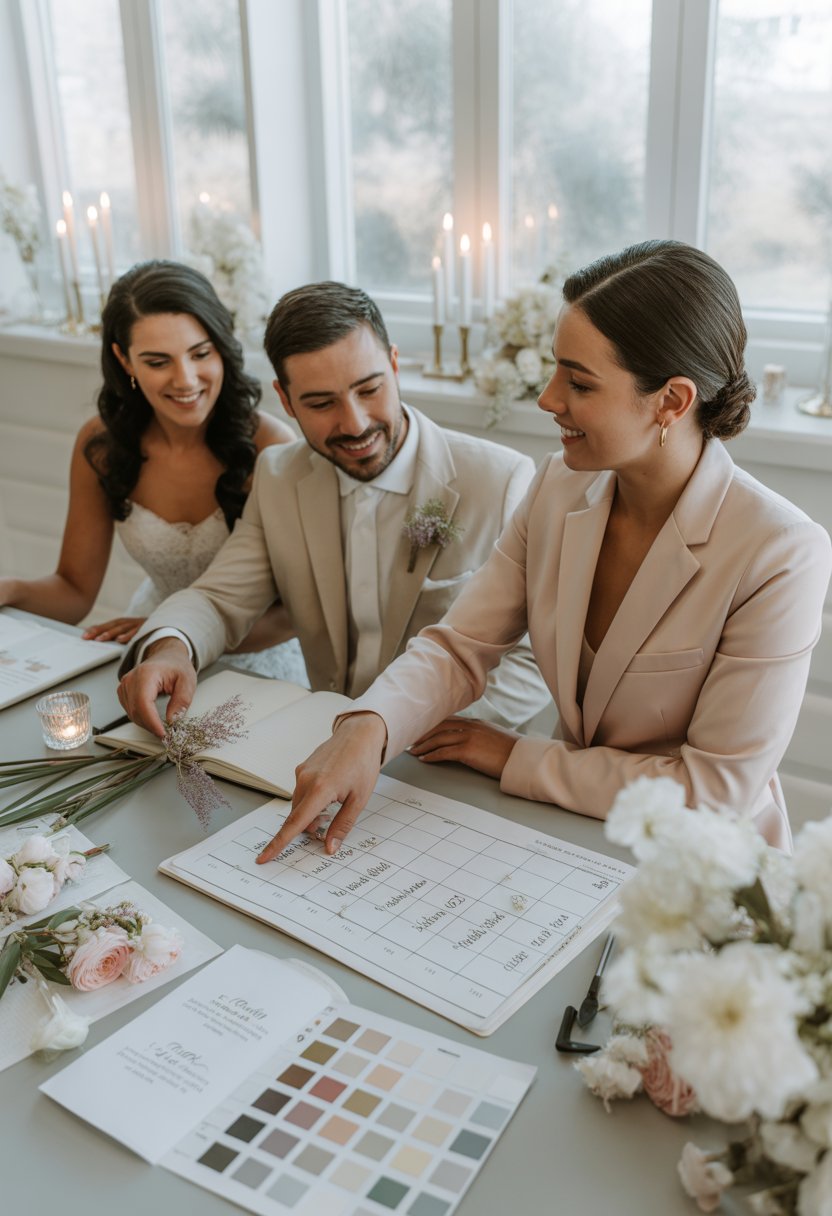
Redundancy is the other real value. If your lead planner breaks an ankle on Thursday, a well-run agency slots in a colleague who can read the same detailed timeline and vendor sheet and run your Saturday. A solo planner’s backup is a favor from a friend who has never seen your file. That is not nothing when the day is unrepeatable.
The solo wedding planner vs agency math tilts toward the firm when the infrastructure actually gets used. Here is what that overhead pays for on a genuinely complex job:
- A shared production timeline that 12 to 15 vendors update in real time, so the caterer and the band are not working off two different call sheets.
- Formal contracts vetted by an attorney, plus a certificate of insurance the venue will accept without a fight the week of the event.
- Volume pricing on rentals and florals: a firm booking 100 events a year can knock 10 to 20 percent off a $15,000 rental order.
- A named backup lead who already has your file, not a friend of your planner meeting you for the first time at the rehearsal.
For luxury weddings and multi-day celebrations, that machinery is often the difference between a beautiful event and a chaotic one. The honest caveat: many agencies charge luxury prices for standard weddings and deliver the same result a strong solo planner would for half the fee. The brand does not guarantee the outcome. What guarantees the outcome is the specific human on your specific day, which loops you right back to getting the name in writing.
Questions That Reveal What You’re Really Getting
The proposal will not tell you what you need to know. The answers to a few pointed questions will. Ask these of both the solo planner and the agency, and compare how they respond, not just what they charge.
- How many weddings do you personally run in a year, and how many are on my month?
- Who is my day-of lead, and will I meet them before the final walkthrough?
- What is your staff-to-guest ratio for a wedding my size?
- What happens, step by step, if my planner cannot be there the week of?
- Can I see a full timeline and vendor sheet from a past wedding like mine?
A solo planner who answers all five crisply is more reliable than an agency that dodges them, and vice versa. The words “we’ve got it handled” are a red flag from either. You want specifics: names, numbers, a document. When you sit down for the first meeting, treat it as a working interview, not a sales pitch you are politely enduring, and read up on how the hiring process works so you know what a normal timeline looks like.
Pay attention to the contract, too. A solo planner’s agreement should still spell out cancellation terms, the deposit (commonly 30 to 50 percent to hold the date), payment milestones, and what her backup obligation is. An agency contract should name your assigned planner or explicitly reserve the right to substitute, and you want to know which. If it lets them swap freely, price that risk into your decision.
Matching the Choice to Your Wedding
Strip away the branding and it comes down to complexity and how much personal attention you want. A wedding under 120 guests, one venue, a normal vendor count, and a couple who values a close relationship is almost always better served by a strong solo planner or a solo-with-assistants. You get more of her, you pay less, and the logistics are within one skilled person’s reach.
A wedding over 200 guests, a multi-day event, a raw venue that needs everything trucked in, or a couple who travels constantly and needs a team that responds even when one person is offline leans toward an agency. The redundancy and the staffing are not luxuries at that scale, they are the job. This is often true for destination weddings, where a team with local partners and on-the-ground backup outperforms a single planner working across time zones.
The worst outcome is paying agency prices for a solo-scale wedding and getting a junior coordinator who inherited your file two weeks out. The second worst is hiring a solo planner for a 280-guest logistics marathon she cannot staff properly and watching dinner service fall apart. Match the tool to the job.
If you are torn between a specific solo planner and a specific agency at similar prices, pick the human you trust who will actually be there. In the solo wedding planner vs agency choice, the name on the day-of timeline matters more than the name on the letterhead. Get that name, get it in the contract, and the rest of the decision gets a lot simpler.