
You get two quotes for the same wedding. One planner asks for a flat $6,500. The other wants 15% of your total budget, which lands around $8,200 on your numbers. Same city, similar reviews, wildly different structure. So which one is actually cheaper, and why do two planners price the same day so differently?
Knowing how wedding planners charge is the fastest way to compare quotes without getting fooled by big round numbers. Only three billing models are in wide use, plus a couple of hybrids, and each rewards a different kind of wedding. Once you spot which model a planner uses, you can judge whether the price is fair. You can also tell whether it will hold when your guest count or scope shifts.
How wedding planners charge: the three core models
Every planner you talk to runs some version of one of these: a flat fee, a percentage of your total budget, or an hourly rate. A smaller group prices “per service” off an à la carte menu, which is really just a bundle of small flat fees. That is the whole landscape. Everything else is a variation on how the number gets calculated.
The model matters because it decides who carries the risk. Pick a flat fee and the planner absorbs it: if your wedding turns out to be more work than they guessed, they eat the extra hours. Go with a percentage and the risk shifts to you, because a creeping budget drags the fee up even when the extra spend created little work. Hourly sits in the middle and leaves the total unpredictable for everyone.

None of these is the honest one or the greedy one by default. A good planner picks the model that fits the work they actually do. A day-of coordinator running a fixed, well-defined scope almost always quotes a flat fee. A full-service planner steering a $150,000 destination build with 22 vendors often uses a percentage. There, the work genuinely scales with the budget. Trouble starts only when the model and the wedding do not match.
Flat fee: what it covers and where it breaks
A flat fee is one number for a defined scope of work. You will see it most often in day-of coordination and partial planning, where the deliverables are easy to pin down. In 2026, flat fees commonly run like this:
- $1,500 to $3,500 for day-of or month-of coordination
- $3,000 to $7,000 for partial planning
- $6,000 to $12,000 for full-service work at the lower and middle end of the market
The appeal is obvious. You know the number on day one and it does not move. That certainty helps a lot. You are already juggling a caterer’s per-head cost, a florist’s 50% deposit, and a venue balance. A flat fee also lines the planner’s incentive up with efficiency. They earn no more when you spend more, so they have no reason to talk you into a pricier florist.
Scope is where it breaks. A flat fee is only honest if the scope is written down clearly. It was priced against specific assumptions: a set guest count, one venue, a normal number of meetings. Push past those and you hit change fees, or a planner who quietly absorbs the work and burns out on your day. Read the contract for what triggers an added charge. A common clause caps included planning meetings at three or four. Another limits the day-of team to one lead and one assistant. Extra bodies get billed separately.
Ask one blunt question of any flat-fee quote. What happens if my guest count jumps from 90 to 140, or I add a welcome dinner the night before? If the answer is “the fee is the fee,” get that in writing. If the answer is a rate for extra scope, get that number too. Most couples underestimate how often the guest list creeps up after the save-the-dates go out.
Percentage of budget: how the math actually works
A percentage model charges a slice of your total wedding budget, usually 10% to 20%, with 15% the most quoted figure for full-service work. On a $60,000 wedding at 15%, that is $9,000. Bump the budget to $120,000 and the same rate becomes $18,000. The logic: a bigger budget means more vendors, more logistics, and more of the planner’s calendar. The fee scales with the work. According to The Knot’s average wedding cost study, the typical U.S. wedding now runs around $33,000. That puts many couples at the low end, where percentage math gets touchy.
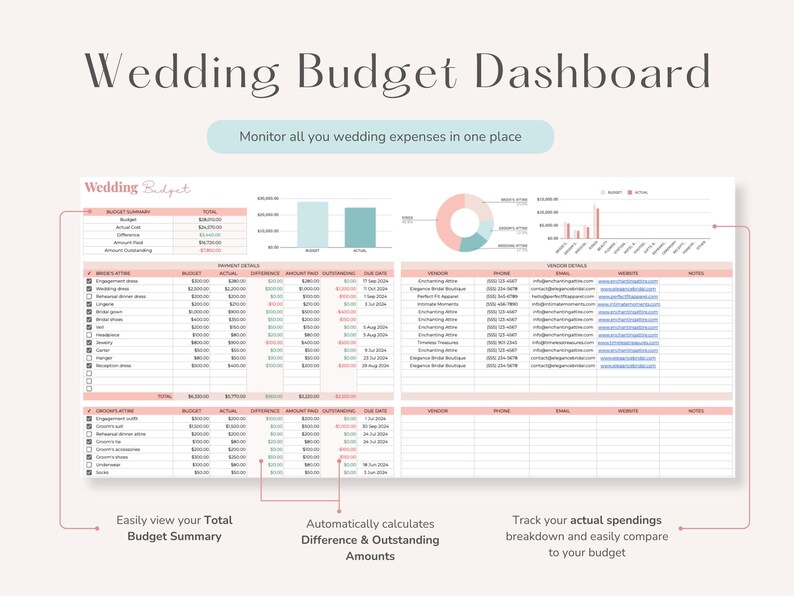
That logic holds up better at the high end than the low end. Coordinating a $200,000 luxury wedding really does involve more moving parts than a $40,000 one. The percentage keeps pay in line with effort. It gets slippery in two spots. First is the definition of “budget.” Does the percentage apply to everything, including your dress and rings? Or only to the vendors the planner actually manages? A planner taking 15% of your rings is billing you for work they never touched. Insist the percentage applies to the managed vendor budget only.
Second is the incentive. On paper, a percentage rewards the planner for pushing your budget up. The fee climbs with your spending. In practice, most reputable planners set a floor, such as “15% or $8,000, whichever is greater.” That keeps small weddings worth their time, and it is where the real number lives for anything under about $50,000. Watch for a percentage with no cap on a large budget. A wedding that grows from $100,000 to $160,000 rarely triples the workload. Yet at a flat 15%, the fee jumps $9,000. A fair version caps the fee, or steps the rate down above a threshold. That keeps the quote from outrunning the actual work.
Hourly and à la carte pricing
Hourly pricing shows up in two situations. The first is consulting-style help, when you want a pro’s brain for a few specific problems. The second is à la carte menus, where you buy discrete tasks. Hourly rates for wedding planners in 2026 typically land between $75 and $250 an hour. The top of that range reflects senior planners in expensive markets. It also covers specialists in destination weddings, where coordination is genuinely harder.
This model fits the couple who has most of the wedding handled and needs targeted help. Think a two-hour session to build a day-of timeline, a contract review, or a venue walkthrough. For a single vendor-contract review, expect one to two hours of billing. That is roughly $150 to $400 at mid-market rates. It is the cheapest way to get professional input when your needs are small and well-defined. It is also the most expensive and most stressful way to run a whole wedding. The meter never stops, and neither of you can predict the total.
À la carte pricing splits the work into buyable pieces: RSVP management at a set price, a design-only package, a rehearsal-and-ceremony coordination block. It is honest and flexible when the menu is clear. The risk is death by a thousand add-ons. Each piece looks reasonable, but the total quietly passes what a full package would cost. Before you build your own bundle, ask what the same items run as an all-in package. Sometimes the bundle is 20% to 30% cheaper than the sum of the parts. That gap is where couples piecing it together tend to overspend.
Do wedding planners get commissions or kickbacks from vendors?
Some do, and you have a right to know. The practice hides behind softer names: referral fees, trade discounts, preferred-vendor commissions. A planner sends you to a florist. The florist pays the planner 10% of your floral spend, and none of it shows up on your invoice. On a $15,000 floral order, that is $1,500 flowing to the planner that you funded without ever seeing it. It is legal in most places and not automatically a scam, but it is a conflict of interest you should be able to see.
The honest version is disclosure. A good planner will tell you outright: “I get a referral fee from three vendors on my list, and here it is in writing.” The best go further and name other vendors they recommend who pay them nothing. That is treating you like an adult. The version to worry about only ever recommends one caterer, one florist, one rental company. They push back on your outside picks. They turn vague when you ask how vendors compensate them. That pattern usually means the recommendation is following the commission, not your interest.

Ask it plainly on your first call. Do you receive any commission, referral fee, or discount from vendors you recommend? If so, from whom? A flat-fee planner has the least reason to steer you, since their pay does not move with your vendor spending. A percentage planner already gains when your budget grows, so vendor commissions stacked on top deserve real scrutiny. Put this next to pricing and contract terms on your list of questions worth asking before you hire.
Deposit and payment schedules: what to expect
No matter how wedding planners charge, you will almost never pay the fee in one lump. The standard structure is a non-refundable deposit to book, called a retainer, then scheduled payments as the wedding gets closer. Retainers commonly run 25% to 50% of the total fee and lock in your date. That money is non-refundable for a plain reason. Once a planner books you, they turn away other couples for that weekend. The retainer covers the date they can no longer sell.
A typical schedule for a $9,000 full-service fee might look like this:
- $3,000 retainer at signing to reserve the date
- $3,000 at a midpoint milestone, often around 120 days out
- $3,000 due 30 days before the wedding
Day-of coordination often uses a simpler split: half to book, half due two to four weeks out. The key detail is that most contracts want the full fee paid before the wedding day, not after. No planner wants to work your wedding with an unpaid balance hanging over it. You would not want them distracted by it either.
Before you sign, pin down three things in writing. First, what portion is non-refundable, and at which points. Next, what happens to your payments if you postpone versus cancel, because those are usually treated very differently. Last, whether the planner’s fee is kept separate from any vendor payment account they manage for you. Those funds should never be mixed. A clean contract states the fee, the schedule, and the refund terms in numbers you can point to.
How to compare two quotes without getting fooled
Everything above about how wedding planners charge comes down to one last step: putting two quotes side by side. Go back to the two from the top, $6,500 flat against 15% of budget. To compare them, convert both to the same thing. Estimate your realistic managed budget, apply the percentage, and set that number beside the flat fee. Then adjust for scope. Say the flat fee buys three meetings, while the percentage planner includes unlimited contact and full vendor management. The higher number can be the better deal per hour of real work.
The trap is judging the fee in isolation. A cheap flat fee can hide a thin scope and a stack of add-on charges. It can easily cost more than a percentage quote that includes everything. Build a simple side-by-side of five things:
- the fee
- what is included
- what triggers extra charges
- the deposit and payment schedule
- whether vendor commissions are in play
When all five sit in front of you, the real price stops hiding. Most couples skip straight to the fee and miss the four columns that actually move the total.
One last check. Ask each planner to walk you through a past wedding at your budget level. Have them tell you what they charged and where the number moved. A planner who can do that from memory has priced enough weddings to quote yours accurately. To see how planners in your area structure fees, browse a few profiles in the full-service planning directory before you reach out. Compare what each one includes.
That is really all there is to how wedding planners charge. Match the model to the wedding, then read the scope line by line. Before your next consultation, write down your realistic managed budget and the one scope change most likely to hit your day. Bring both to the call. The planner who prices those honestly, in a model that fits your wedding, is usually the one worth hiring.