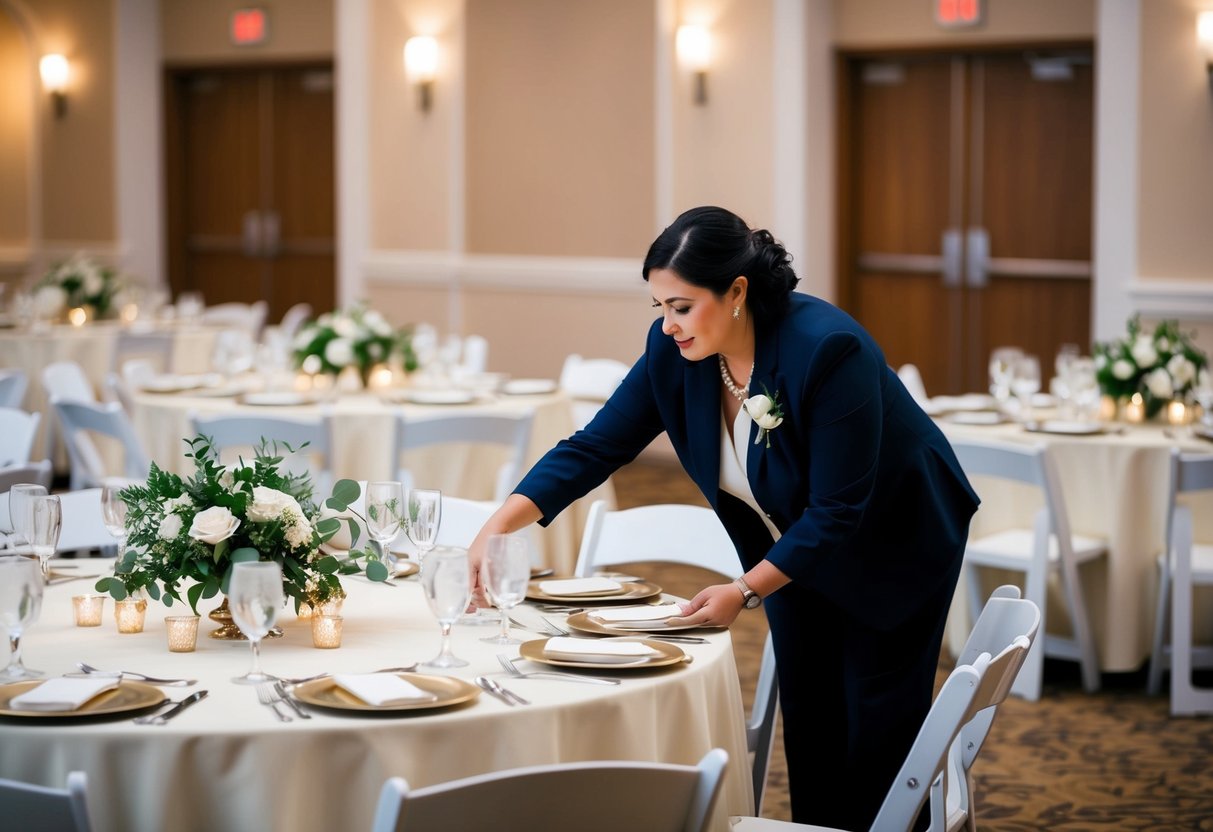
A 180-guest vineyard wedding, one coordinator, no assistant. At 4:40 p.m. she was inside the barn flipping ceremony chairs into a dinner room. Outside, the second hotel shuttle unloaded 40 early guests at the top of a gravel driveway, with nobody to point them toward the bar. Both jobs needed a person at the same minute. There was one.
How many wedding coordinators do you need on site is a question most couples never think to ask until they are watching the answer play out. Planners think about it constantly. Staffing is the largest variable cost buried inside a coordination fee. It is also the fastest way to burn a venue referral relationship. Guest count is where the conversation starts. It is not where it ends.
How Many Wedding Coordinators Do You Need for Your Guest Count
How many wedding coordinators do you need at each size? Start with the ranges that hold up across most of the country in 2026. These assume a single venue, a catering team running its own service, and a 10 to 12 hour coordinator day.
- Under 50 guests: one experienced coordinator, provided the caterer has a captain on the floor.
- 50 to 120: a lead plus one assistant for the back half of the day. That usually means ceremony setup through the first dance.
- 120 to 200: a lead plus a full-day assistant. Skip the assistant here and the timeline has slid about 25 minutes by the time salads drop.
- 200 to 300: a lead plus two.
- 300 and up: a lead plus three or four. At that size the lead runs the floor by radio, not by carrying boxes.

The working rule most planners use: one staffer for the first 100 guests, then one more for every additional 75. A 250-guest wedding lands at three. That ratio tightens to one per 50 in a few specific cases. Plated service with escort cards, a toast program with more than four speakers, or eight vendors loading in through the same door inside a 90-minute window.
It loosens in a hotel ballroom. A banquet captain, a house AV tech, and a staffed coat check all mean borrowed labor nobody billed you for. A converted warehouse with one freight elevator and a restroom trailer in the back lot gives you none of that. My honest take: couples pour real money into florals, then try to save $450 on staffing. The assistant is the person who makes sure those flowers reach the right room at the right hour. Ask any candidate for day-of coordination what their standard team size is at your guest count. Then ask whether that number is in the contract or quietly decided in the final month.
What the Second Coordinator Actually Does
The lead’s job is to stand next to the decisions. Everything that would otherwise pull the lead away from those decisions belongs to the assistant. That sounds abstract until you lay it over an actual afternoon.
At 3:50 the rental company shows up 40 minutes early with 22 farm tables and a delivery sheet that needs a signature. Fifteen minutes later the caterer asks whether the head table gets the linen the couple upgraded to in April. Then the officiant misplaces the marriage license. By 4:25 the wedding party needs lining up in processional order, in a suite 200 feet from the ceremony lawn. Somebody has to cue the string trio five minutes after that. One person cannot do all five. With a single coordinator, the license wins and the rental count gets signed blind. That is how couples end up disputing a $340 shortage charge in July.
The rest of an assistant’s day is unglamorous and load-bearing:
- Pinning personal florals on 11 people while the lead is with the couple.
- Walking the guest using a wheelchair to the accessible path instead of the gravel one.
- Holding the photographer’s 7:20 sunset window against a DJ who wants toasts early.
- Watching the gift table, then boxing 30 unclaimed favors at the end of the night.
Teams doing full-service planning usually split this three ways. A design lead owns the look, a production lead owns the clock, and an assistant owns the floor. On a 150-guest wedding, that third person is why the lead can stand beside the couple. Those two hours before the ceremony are where mistakes cannot be undone.
When Guest Count Is the Wrong Number to Staff By
Guest count is a proxy, and it fails in predictable places. An 80-person wedding with a church ceremony 18 minutes from the reception venue needs two coordinators, full stop. Nobody can receive a 3:00 floral delivery downtown and line up a processional across town at the same time. Geography beats headcount every time.

The flip is its own staffing line. If the ceremony and dinner share a room, somebody has to move 180 chairs and reset 18 tables. That happens inside the 60 to 75 minutes of cocktail hour. Venues will tell you the caterer handles it. The caterer’s contract usually covers tables and chairs. It does not cover your candles, the escort display, or the arbor that has to reappear behind the head table. Two coordinators and a caterer’s crew can flip a 180-seat room in 50 minutes. One coordinator cannot, and the difference shows up as guests standing in a hallway at 7:15 with empty glasses.
Raw and tented venues are the other big multiplier. A field with a generator, a rented kitchen tent, and no in-house staff makes your coordination team the venue team. Trash, ice runs, restroom checks, and a load-in path that turns to mud in a Thursday storm all land on your people. Add a staffer, sometimes two. Budget $400 to $900 for that alone. File it under venue cost, not planning cost, because that is what it is.
Multi-day weekends stack the same way. A Friday welcome party, a Saturday wedding for 170, and a Sunday brunch is three events across 36 hours. Nobody runs the third one well on four hours of sleep. You are paying for rotation there, not raw ratio. A planner who quotes the same two-person team for all three days has not read the schedule closely.
Ceremony traditions change the arithmetic too. A few that routinely need a fourth person at guest counts where a Saturday-afternoon garden wedding needs two:
- A baraat that closes a street or a hotel drive for 20 minutes.
- A tea ceremony for 40 family members before the main event.
- A 90-minute mandap build running against cocktail hour.
- Two or three outfit changes with a dedicated attendant.
Planners who specialize in cultural weddings price this in from the first call. Self-catered receptions and food-truck service belong on the same list. No service staff means your coordinators become the service staff, and that is not what you hired them for.
What Extra Coordinators Cost and Who Pays for Them
In most mid-size markets in 2026, an assistant coordinator costs the planner $300 to $650 flat for an 8 to 12 hour event day. In New York, Los Angeles, the Bay Area, and at the luxury tier, that range runs $500 to $900. A subcontracted second lead who can run a room alone bills $800 to $1,500. Hourly arrangements land between $35 and $75. Some planners pass that through at cost. Others mark it up 25 to 40 percent to cover scheduling, training, and the risk of a no-show.
Read how it appears on your contract. Good language reads something like this: staffing includes one lead planner and one assistant for 12 hours. Additional assistants billed at $450 per person per event day, confirmed no later than 45 days prior. Vague language reads: staffing as determined by planner. The second version is not automatically a problem. It does mean you will not know your team size until the month-of meeting, when you have no room to negotiate.
Two costs surprise couples. Vendor meals come first. Every staffer on site for a 12-hour day needs one. Caterers charge $45 to $95 per vendor plate, so a three-person team adds $285 to your catering invoice. Overtime is the other. Most contracts bill $100 to $200 per hour per staffer past the contracted end time, often in 30-minute increments. The usual trigger is a reception the couple extends at 10:45 p.m.
For a destination wedding, each additional staffer means a flight and two hotel nights. Add a per diem of $50 to $75 a day on top. That is why a planner quoting a Tulum weekend at 200 guests staffs leaner and leans on local crew. Before you decide you are a small wedding, check your number against the national picture. The Knot’s Real Weddings Study puts the typical U.S. celebration near 115 guests. That is right at the line where a second body stops being optional.
What Understaffing Actually Looks Like on the Day
It rarely looks like disaster. It looks like a slow leak. The cake arrives at 3:15 and nobody is at the service door. The driver leaves it on a table in direct sun for 20 minutes. Ceremony starts 12 minutes late because the wedding party lined itself up wrong. Nobody flags that the caterer is 15 minutes behind on plating, so cocktail hour runs long. Toasts begin while the couple is still outside finishing portraits. By 9:00 p.m. you are 35 minutes off the timeline. The photographer you booked until 10:00 leaves before the sparkler exit.
Teardown is where thin staffing bites hardest, and couples never see it coming. Rentals must be stacked, bagged, and staged by a contract deadline, often 11:30 p.m. or 8:00 the next morning. Restacking fees of $150 to $400 are routine. One coordinator who has been on her feet since 8:00 a.m. cannot do all three. Break down a 200-person room, load your decor into two cars, and account for a $600 cake stand deposit.

There is also the single point of failure nobody wants to discuss. Say the only person holding your timeline gets food poisoning on Friday night. Or is rear-ended on the 405 at 2:00 p.m. Saturday. A two-person team absorbs that. A one-person team does not. Ask what the backup plan is. Ask whether that backup gets your timeline and vendor contact sheet in advance, or a phone number in an emergency. If the answer is a name you have never heard, ask to meet them.
For Planners: Staffing a Team Without Killing Your Margin
Run the math before you fall in love with a package price. Charge $2,800 for month-of coordination, then pay an assistant $450 plus $60 in mileage plus a vendor meal. You have given back roughly 18 percent of the revenue. Go to three staff on a 250-guest wedding and you are near 35 percent. That is against 65 to 85 hours of your own time across the engagement.
The fix is not paying assistants less. Price the second body into your base rate at 100-plus guests so it never turns into a month-11 upsell conversation. Then quote a per-assistant rate above that. Couples argue with a $450 line item. They rarely argue with a package that already includes a team.
A few practical things hold a bench together across a season:
- Pay within seven days, ideally same-day by transfer, if you want the same people answering in June.
- Build a roster of four to six trained assistants once you run 20 weddings a year. Two will always be booked.
- Have new hires shadow three full weddings before they own a section.
- Buy real radios with earpieces. A set of four runs $180 to $400, and a 300-guest room cannot be run on group text.
- Duplicate your emergency kit so the assistant in the suite is not walking 400 feet for a safety pin.
Worker classification deserves a real conversation with your accountant, not a rule of thumb from a Facebook group. Set the schedule, direct the work, provide the tools, require a uniform, and several states call that an employee. The IRS test for independent contractor status weighs behavioral control, financial control, and the type of relationship. Planners building a team and wanting steadier lead flow can list a planning profile. Couples can then filter by the service they actually need.
Questions to Ask Before You Sign the Contract
Five questions surface almost everything you need to know about a planner’s staffing model:
- How many people from your team will be on site, and for which hours of the day?
- Is that number written into the contract, and does it change if my guest count goes from 140 to 190?
- What does an additional assistant cost, and what is the last date I can add one?
- Who covers my date if you are sick or in an accident, and do they receive my timeline in advance?
- Do your staff require vendor meals, and should I add them to my catering count?
Listen for whether the answers get more specific as you add detail. Say you describe a single-venue garden wedding, then a church ceremony across town followed by a tented reception on a private estate. A planner who says two people either way is quoting a template, not a plan. A planner who asks about your ceremony-to-dinner flip and your load-in door is doing the arithmetic in real time. So is the one who asks whether your caterer brings its own captain. That is the person you want holding the radio.
So, how many wedding coordinators do you need? For most weddings between 120 and 200 guests at a single venue, two. Add one for a second location, a raw venue, a multi-day schedule, or a guest count past 200.
Before your next planner call, write down three numbers. Your projected final guest count, how many separate locations the day touches, and how many minutes sit between the ceremony and dinner. Those three numbers set your team size better than any package name on a PDF. Bring them to two or three quotes and see how the matching process works before you sign.