
The maid of honor is crying in the bridal suite. The zipper on the bride’s dress just split three teeth. It’s 3:40 p.m., and guests start arriving at 4:00. You have twenty minutes. What you reach for now decides everything. Fix it fast, and no one notices. Fumble, and the ceremony starts forty minutes late with a rattled bride. That reach is your wedding day emergency kit, and it is the most useful piece of gear a coordinator owns.
I’ve run more than a hundred weddings. I can count on one hand the events where I opened the kit zero times. Most Saturdays I open it four or five times before the first dance. Your wedding day emergency kit is not a Pinterest prop; it is a working tool. The couples who hire you are paying for one thing, whether they say it or not. You are the person who already solved the problem before they knew they had one.
What your wedding day emergency kit has to fix, and how often
Before you buy a single safety pin, learn the failure modes. They drive the packing list. Over a season, the repeat offenders cluster into three groups. Wardrobe malfunctions come first: busted zippers, popped buttons, broken bra straps, a hem stepped through during the first look. Personal-care crises come next: deodorant on a dark suit, a bloody nose, a nervous stomach on an empty one. Then the small physical failures. A boutonniere won’t stay pinned. A cake table wobbles. A unity candle dies in the wind.
The pattern matters more than the list. Roughly 70% of what I fix is wardrobe or personal care. Maybe 20% is decor and setup. The last 10% is the genuinely weird. A ring bearer loses the ring pillow. A groom forgets dress socks. A flower girl gets a nosebleed on a white dress ten minutes before she walks. You cannot pack for every strange thing. You can pack so that 90% of the day never reaches the couple’s ears.
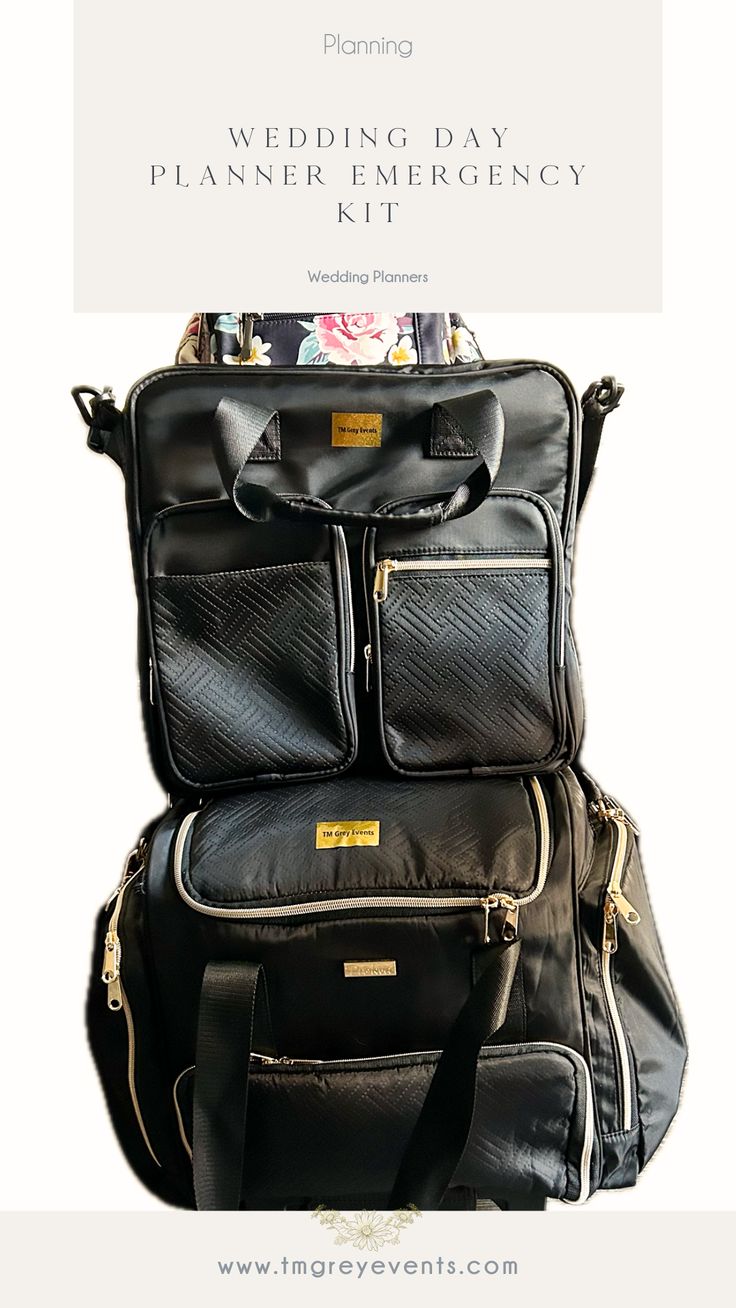
The honest truth is that a good kit is less about heroics and more about probability. Each item earns its place by how often it gets used against what it weighs and costs. A pack of safety pins gets used almost every wedding and costs two dollars. A portable steamer earns out maybe one wedding in six. It still stays in the car, because a bride in a creased dress remembers it forever.
One example sticks with me. A groom’s father split his suit seam bending to fix a flower girl’s shoe, ninety seconds before the processional. A large safety pin and a strip of fashion tape held it through the whole ceremony. Nobody in the pews ever knew. That is the entire job: quiet fixes that never become a story.
The core kit: wardrobe and sewing
This is the bag you keep within ten feet of the bride all day. Some coordinators wear it. If you build only one kit, build this one. Real quantities matter, because running out at 3:40 is the same as not having it at all.
- Safety pins in three sizes, at least 50 total. Small gold ones for boutonnieres, medium for bustle failures, large for the emergencies you haven’t met yet.
- A pre-threaded sewing kit with white, black, and ivory thread, plus a spool of clear thread. Add self-adhesive dress tape, 10 to 12 strips minimum, because they go fast.
- Fashion tape and double-sided body tape, two packs. Necklines, lapels, and gaping button plackets all fail on schedule.
- A stain pen, a Tide-style stick, and a small bottle of hydrogen peroxide for blood on white fabric. Peroxide lifts blood; club soda does not.
- Extra buttons, sharp scissors, a seam ripper, and clear nail polish. The polish stops a stocking run and locks a loose button thread.
Add a lint roller, a fabric shaver for the pilled tuxedo jacket, and a Tide-to-Go pen you have actually tested. Most of my wardrobe saves involve no sewing at all. It’s dress tape on a neckline, or a safety-pinned bustle so the bride can dance. Learn the French bustle and the ballroom bustle before you ever fix one on a reception floor. Practicing on your own coat once is worth more than any single tool in the bag.
Organization beats capacity. I keep wardrobe fixes in one clear zip pouch, meds in a second, and tools in a third, all labeled. At 3:40 you do not want to dig; you want to grab the right pouch and move.
Personal care and the stuff nobody packs for themselves
Half the kit exists because adults under stress forget the basics. The wedding party skipped lunch. Someone is hungover. The groom’s mother feels a migraine coming on, and it’s 94 degrees in the tent. You become the pharmacy, within legal limits.
Stock single-dose, individually wrapped packets: ibuprofen, acetaminophen, antacids, antihistamines, and anti-diarrheal tablets. Never a loose bottle, always sealed doses. Offer, never administer. Say ‘here’s what this is, take it if you want it,’ and leave the choice with them. Add bandages in several sizes and blister pads, because new heels are a bloodbath. Round it out with antiseptic wipes, eye drops, saline, and a small bottle of unscented lotion.

Then the dignity items. Deodorant, both a clear stick and a travel spray. A stain remover for the marks the deodorant just made. A toothbrush, travel toothpaste, floss, mints, and mouthwash. A comb, bobby pins by the dozen, hair ties, travel hairspray, and a compact mirror. Tampons and pads in two absorbencies, no discussion. A charging brick with cables for both phone types. The second shooter will need it, and so will the bride’s sister running the group texts.
One small thing punches above its weight: single-serve snacks and electrolyte packets. Feed a bride a granola bar and water at 2:00 p.m. She does not faint at the altar at 4:30. I’ve caught two fainters in my career. I’ve prevented far more with a protein bar and a firm ‘eat this now.’
Heat is the quiet villain at summer weddings. A battery-powered handheld fan and a pack of cooling towels keep a wilting wedding party upright between photos. I add both from June through September without thinking about it.
Decor, setup, and the tools you’ll actually use
The couple assumes the venue and florist handle setup, and mostly they do. But you are the one holding the wobbling cake table. You re-pin the aisle runner the wind lifted. You hang the sign that arrived with no hardware. A modest tool roll saves the reception.
Carry a multi-tool or a small screwdriver set, a hammer, a staple gun, and zip ties in several lengths. Pack gaffer tape, not duct tape, because gaffer pulls up clean and won’t ruin a floor. Add painter’s tape, super glue, floral wire, floral tape, and clear fishing line. A hot glue gun earns its spot if you have a battery model or a nearby outlet. Keep extra-long lighters and stick matches too, because unity candles and sparkler send-offs die in wind.
Batteries deserve their own pouch. Carry AA, AAA, and a couple of 9-volts. The DJ’s mic, the fairy lights, the fake candles, and the card-box lock all run on batteries. Every one of them dies at the worst moment. Throw in a small flashlight and a headlamp for the dark-parking-lot breakdown at midnight. Owning a real tool roll is part of what separates a professional from a friend doing a favor. That gap is exactly what couples pay to close when they book day-of coordination instead of drafting a cousin.
The tool roll also settles disputes fast. When the rental company’s arch showed up with a stripped bolt last June, a multi-tool and two zip ties had it standing before the couple arrived. Rentals fail more than anyone admits, and the venue rarely keeps a toolbox on site.
Paperwork, contacts, and the digital kit
The physical kit gets the attention. The information kit prevents the disasters safety pins can’t touch. Print three things on paper. Start with the master timeline. Add the vendor contact sheet with cell numbers, and the floor plan with the seating chart. Print them, because the venue wifi will fail and your phone will hit 3% by the toast.
Your vendor sheet should list every vendor, their arrival window, and their point person’s mobile number. Add a one-line note on what each one owes you. The baker’s delivery time, the DJ’s last-song cutoff, the shuttle company’s pickup address. When the shuttle runs twenty minutes late, you call the driver directly instead of scrolling your inbox. Keep a copy of every signed vendor contract in a folder or an app. The moment a caterer tries to leave before their contracted 11:00 p.m. end time, that clause is your leverage.

The digital half lives on your phone. Keep a shared drive with the same documents and the couple’s design board. Add a running tip-and-payment tracker and a weather app you actually check that morning. Build a reusable template so you aren’t rebuilding it for every event. Share the folder with your second coordinator and the couple’s point person. The timeline then survives even if your phone drowns in a champagne toast. The way we structure client intake and timelines is laid out in how it works. A tight system is what makes the wedding day emergency kit rarely necessary in the first place.
Sizing your wedding day emergency kit to the event
A 40-guest elopement in a state park and a 280-guest ballroom do not need the same bag. Hauling a rolling case up a cliff trail is its own emergency. Scale the kit to the event.
For an intimate or outdoor wedding, I run a lean crossbody version. It holds wardrobe basics, personal care, the paper timeline, a phone battery, and a windproof lighter. It also carries bug spray and sunscreen that the ballroom kit skips. For a large formal wedding, the full rolling case comes in, staged in a back room. The crossbody still rides on my body as the go-bag. The rule is simple. Whatever you need in the first 90 seconds lives on you. Everything else can be a two-minute walk away.
Destination and outdoor work adds its own list. Pack sunscreen, insect repellent, extra water, and a battery fan. Bring blister care in bulk, because sand and heels punish feet. Add a poncho or two and a backup pair of flats for a bride whose feet have quit. Maybe you specialize in destination weddings, or you work the elopement and small-ceremony end of the market. Either way, weight drives every packing choice. A cheap dry bag keeps everything usable when an afternoon shower rolls through an outdoor ceremony. You’ll refine the list after the first wedding where you carry too much a half mile uphill.
What a wedding day emergency kit costs to build and maintain
A complete, professional-grade wedding day emergency kit runs $150 to $300 to build from scratch. Most of that is one-time. The recurring cost is the consumables: dress tape, safety pins, medication packs, bandages, batteries, and stain sticks. You burn through those and restock them. Budget $30 to $50 a season to replenish. Audit the kit the Monday after every wedding, not the Friday before the next one when you’re already slammed. Keep every receipt, because a professional kit is a deductible business expense. The IRS lets you write off ordinary tools of your trade, so log what you spend as you restock.
Build it once and it becomes invisible infrastructure. The couples paying you $1,800 for coordination, or $6,000 and up for full-service planning, are not itemizing your safety pins. National averages from The Knot’s average wedding cost report put the typical wedding well into five figures. Against that, a $300 kit is a rounding error. What they pay for is the calm of you already having the answer. A restocked kit is cheap insurance against the review that opens with ‘the zipper broke and nobody could fix it.’
Restock the kit tonight, while the last wedding is fresh. Note what you opened and what you wished you’d had. Then add that one item before it becomes the story of your next Saturday. A wedding day emergency kit is never finished; it just gets a little smarter after every save.