
You booked the venue, you have a Pinterest board with 340 pins, and your mother-in-law keeps asking who’s “running the show” on the day. So can you actually plan a wedding without a wedding planner? Plenty of couples do, and some pull off a better day than couples who paid $8,000 for full service. The honest answer depends on three things: your guest count, your venue, and how many free hours you have between now and the wedding.
I’ve coordinated weddings where the couple did 95% of the work themselves and only hired me for the final six weeks. I’ve also watched fully DIY weddings unravel at 4 p.m. because nobody was assigned to tell the band when to start the first dance. What follows is a walk through what going without actually looks like, where it works, and where it quietly falls apart.
What it takes to plan a wedding without a wedding planner
Strip away the word “planner” and look at the job underneath it. You research and book eight to twelve vendors. You read and negotiate every contract, build a payment calendar, and design the floor plan. Then comes the run-of-show timeline down to the fifteen-minute block, the week-before confirmation calls, and directing all of it on the day itself. When you are also the person getting married, that last part is the catch.
Plan a wedding without a wedding planner and you absorb roughly 200 to 300 hours of work for a 120-guest event. That number surprises people. It covers venue and vendor research, tastings and site visits, dozens of email threads, a seating chart that will change four times, and the grind of tracking deposits. A typical schedule front-loads about 40 hours of research in the first three months, goes quiet for a stretch, then hits a brutal 60 to 80 hours in the final eight weeks.
It helps to see the calendar the way a planner does. Twelve months out, you lock the venue and the date. Around nine months, you book the caterer, photographer, and band, the vendors that sell out first. At six months, invitations go to the printer and rentals get reserved. Six weeks out, you send the final headcount, build the timeline, and confirm every arrival window. Miss one of those milestones and the next one gets more expensive, because the good vendors are already booked.

None of this is beyond a capable, organized couple. The skills are project management, negotiation, and design, not magic. What it demands is time and a tolerance for logistics. If you both work 50-hour weeks and travel for your jobs, the math gets tight fast. If one of you genuinely enjoys spreadsheets and vendor emails, you have an advantage most couples don’t.
The weddings you can realistically DIY, and the ones you can’t
Guest count and venue type tell you almost everything. A wedding under 50 people at an all-inclusive venue, one that provides tables, chairs, catering, and an on-site coordinator, is very DIY-friendly. The venue absorbs the heaviest logistics, and you are mostly choosing options from a menu. Couples plan these solo all the time and barely break a sweat.
The difficulty climbs with every layer you add. A 150-guest wedding at a raw space, a barn, a private estate, or a public park, is a different animal. Raw venues mean you rent everything: tables, chairs, linens, glassware, lighting, generators, sometimes even the portable toilets. You are coordinating six or more independent vendors who have never worked together. You are building the infrastructure a hotel would have handled invisibly. That is where DIY couples get in over their heads.
The numbers make this concrete. A full rental package for 150 guests, tables, cross-back chairs, china, flatware, glassware, and a basic tent, routinely lands between $6,000 and $12,000 before delivery fees. Add cafe lighting at $800, a generator at $400 a day, and a two-stall restroom trailer at $1,500, and you are running a five-figure logistics operation on top of catering and photography. Every one of those line items has its own delivery window, its own contact, and its own thing that can go wrong on setup morning.
Here’s a rough guide to where solo planning holds up:
- Very doable: under 60 guests, all-inclusive venue, local vendors, a wedding party willing to help set up.
- Doable with effort: 60 to 120 guests, a semi-inclusive venue, a partner who handles logistics well.
- Risky solo: 120-plus guests, a raw or outdoor venue, multiple rentals, or a tight one-day setup window.
Destination weddings sit in their own category. Planning one from 2,000 miles away without a local contact is where most couples finally admit they need help. It’s worth seeing what a destination wedding specialist actually handles before you assume you can manage it over email in a different time zone.
The real cost of going without: your time
Couples skip a planner to save money, and the savings are real. A full-service planner runs $4,000 to $12,000 for a mid-range wedding, often 10 to 15% of the total budget, a range in line with The Knot’s annual cost study. Skip that and the money goes toward your bar, your photographer, or your honeymoon. Fair enough. But you are not getting the work for free.
Do the arithmetic on your own time. If planning eats 250 hours and you value your time at even $30 an hour, that’s $7,500 of unpaid labor. This doesn’t make hiring a planner the automatic better deal, because some of those hours are genuinely fun and you’d spend them happily. It does mean “free” is the wrong word. The real question is which hours you are trading and whether you have them to trade.

There’s also a hidden tax people forget: the mental load. Even when you’re not actively working on the wedding, an unfinished plan sits in the back of your head for a year. You’ll draft catering emails in the shower. You’ll wake at 2 a.m. remembering the shuttle is still unconfirmed. Some couples handle that low hum fine. For others it poisons what should be a joyful engagement, and the money spent on a planner buys back their peace. If you want a sense of the middle-ground options, our breakdown of how wedding planners charge lays out the range between full service and hiring nobody.
Building your own vendor team without a planner’s rolodex
A planner’s real value isn’t the timeline. It’s the phone. They know which caterer never runs out of food at 130 covers, which DJ reads a room, and which florist quietly pads invoices. Without that network, you’re vetting strangers from Instagram and Google reviews, and reviews are easy to fake. This is the part of solo planning that carries the most financial risk.
Read past the headline number, too. A caterer’s $95-per-head quote can hide a 22% service charge, a $500 cake-cutting fee, and rental delivery that isn’t included, which turns a $95 plate into $130 by the time you sign. Ask for an all-in quote with every fee itemized, and compare vendors on that total, not the teaser rate. This is where cheap day-of quotes hide expensive surprises.
Protect yourself by reading contracts like a skeptic. Watch the deposit structure: most reputable vendors take 25 to 50% to hold the date, with the balance due seven to fourteen days before the event. Anyone demanding 100% upfront is a red flag. Check the force-majeure clause. It governs what happens if a hurricane or another shutdown cancels the day, so make sure it offers a credit or reschedule, not a total forfeiture. Confirm the cancellation window and exactly what triggers a refund.
Ask every vendor these five questions before you sign:
- How many weddings do you book on my date, and will the person I’m meeting be the one who shows up?
- What’s your deposit, and when is the balance due?
- What does your contract say about cancellations and postponements?
- Can you send two references from weddings in the last six months?
- What happens if you’re sick or have an emergency on my wedding day?
That last question matters more than couples realize. A solo photographer with no backup and no answer is a gamble. Build in your own redundancy where you can, and keep a written record of every promise. Verbal agreements evaporate the moment there’s a dispute.
The month-of gap nobody warns you about
Here is where I’ve seen the most DIY weddings stumble, and it has nothing to do with planning ability. You can research and book flawlessly for a year, then hit a wall on the wedding day itself. You physically cannot be getting your hair done and directing the rental delivery at the same time. Someone has to run the day, and if that someone is you, you’re not a guest at your own wedding.
I worked a backyard wedding last summer where the couple did everything right for eleven months, then tried to run the day themselves. By 5 p.m. the bride was in her dress fielding a call about where the rental van should park while photos waited. Her cousin ended up directing the caterer with zero context. Nothing burned down, but the couple spent their cocktail hour solving problems instead of greeting guests, and they told me afterward it was the one thing they’d change.
The symptoms are predictable. The florist arrives while you’re taking photos and has no one to tell where the arch goes. The caterer needs a decision about moving dinner up twenty minutes and can’t find anyone with authority. Grandma is hunting for her seat and asking your maid of honor, who is also supposed to be in photos. Every small question lands on whoever is closest, and the day drifts instead of running.
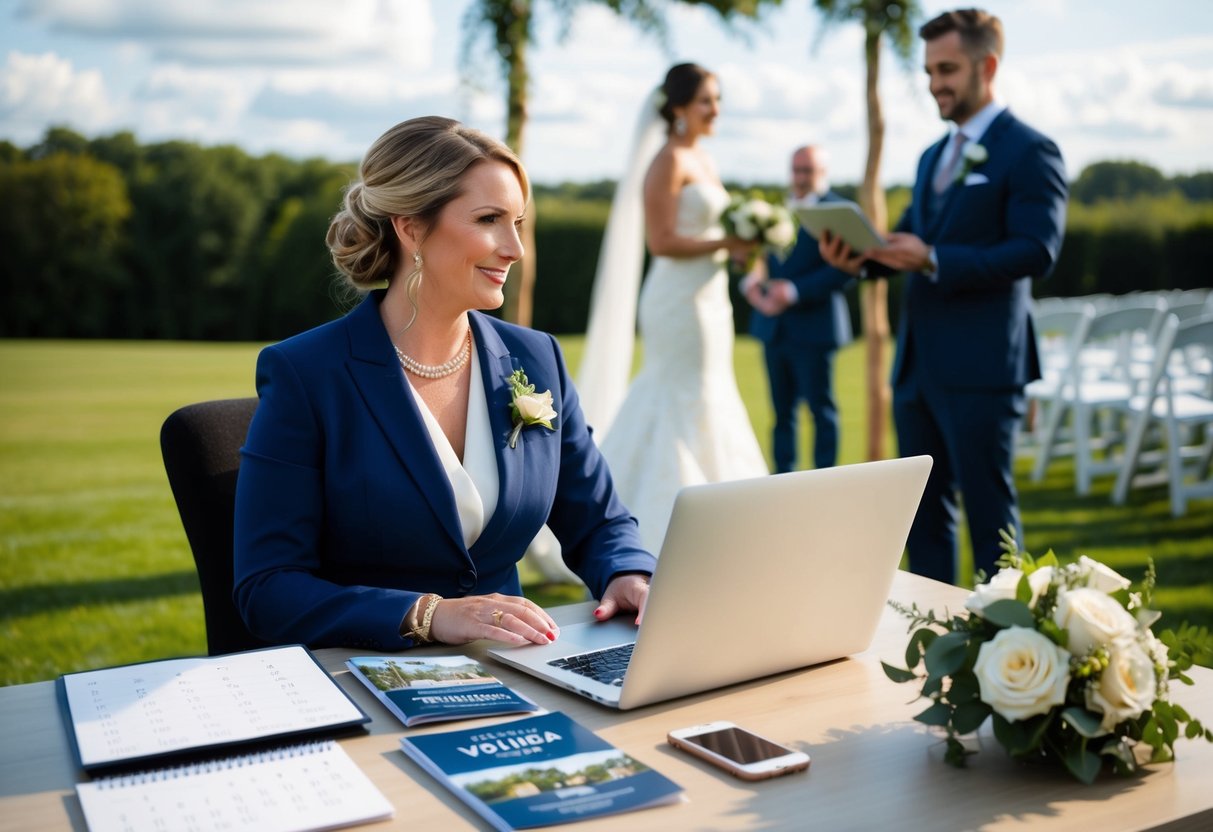
This is exactly why day-of coordination exists, and it’s the most common compromise for otherwise-DIY couples. For roughly $1,200 to $2,500, a coordinator takes your plan and executes it so you can attend your own wedding. Many prefer to start four to six weeks out, which is really month-of coordination: they review your contracts, clean up your timeline, confirm every vendor, and become the point of contact so your phone stops buzzing. If you do one thing after reading this, price out this option before you commit to running the whole day yourself.
When to hire help even if you’re mostly DIY
Going solo isn’t all-or-nothing, and the smartest DIY couples treat it as a spectrum. You might do all the research and design yourself, then hire a coordinator for the final stretch. You might bring in a designer for a few hours to lock the aesthetic, then execute it on your own. Partial support is often the highest-value money in the whole budget, because it plugs the exact gap where your time or expertise runs out.
A few signals that you should buy help even on a tight budget:
- Your venue is raw and you’re managing more than five separate rentals.
- Your guest count crosses 120.
- You’re planning from another city and can’t do site visits.
- You and your partner are both stretched thin at work and already snapping at each other over the seating chart.
Any one of those is a reason to redirect money from a softer line item, your flowers or your cake, toward coordination. A budget-friendly planner or an a la carte coordinator can cover the danger zone for a fraction of full-service pricing.
There’s no shame in deciding, halfway through, that you’d rather hand it off. I’ve picked up couples at the six-month mark who started strong and burned out. The plan they built was solid; they just didn’t want to carry it alone anymore. That’s a perfectly good reason to spend the money, and it usually costs less than starting fresh because the groundwork is already done.
So, can you plan a wedding without a wedding planner? For a small, contained, well-supported wedding, absolutely, and you’ll be proud you did it. For anything large, raw, or far from home, be honest about the hours and the day-of gap before you commit. The best move for most DIY couples isn’t hiring nobody or hiring everybody. It’s booking a coordinator for the last six weeks and running the rest yourself. Price that out this week, before your favorite date is gone.