
Say you are planning a wedding that spans three days and two faith traditions, with 350 guests. Friday night is the mehndi. Saturday brings a ceremony that needs a mandap and a fire marshal sign-off. Then comes a reception where the caterer has to run a strict halal kitchen next to a full bar. You call a planner you liked from a friend’s backyard wedding. Within ten minutes you can tell she has never staged a baraat. That gap is exactly why couples go looking for a multicultural wedding planner. The fee looks nothing like what your coworker paid for her Saturday-afternoon vineyard wedding.
A multicultural wedding planner runs weddings that blend two or more cultural or religious traditions. She also handles a single tradition carried across several days with heavy ritual. Think a full South Asian, Nigerian, Chinese, Jewish, or Persian celebration, or any fusion of them. The job is not harder because the families are different. It is harder because the event count multiplies. You get more moving parts, families with strong and sometimes competing opinions, and rituals that carry logistical requirements a generalist has never had to solve.
What makes a multicultural wedding planner different
The difference is not cultural sensitivity in the soft sense. It is operational. A standard one-day wedding has a single timeline: hair and makeup, first look, ceremony, cocktail hour, reception, exit. A South Asian wedding weekend can carry a mehndi, a sangeet, a haldi, the ceremony, and a reception across three or four days. Each of those has its own vendor list, guest count, and venue.
That means a multicultural planner is really running three to five weddings back to back. Each event gets its own run-of-show. The decor team has to strike and reset a room overnight, sometimes turning a mehndi space into a ceremony hall by 7 a.m. On top of that, she is managing families who hold firm, non-negotiable views about who walks in when and what gets served.

Then there is the ritual logistics no couple thinks about until something goes wrong. A baraat needs a permit and a route if it moves down a public street. Open-flame ceremonies are worse: a fire ritual requires a venue that allows an indoor flame, which rules out roughly half the hotel ballrooms in most cities. Slot a tea ceremony in wrong and it collides with the photo timeline, so it needs a quiet room and its own window. A planner who has run twenty of these already knows the venue’s answer before she asks. That accumulated knowledge is most of what you are paying for.
What a multicultural wedding planner costs in 2026
Pricing follows the two models you see across the industry, but the numbers run higher because the scope is bigger. A multicultural wedding planner who charges a percentage typically takes 12 to 18 percent of your total budget. On a $120,000 South Asian wedding weekend, that lands between $14,400 and $21,600 for full-service planning. Flat-fee specialists in multi-event weddings usually quote $8,000 to $25,000. The spread comes from guest count, the number of events, and how much design work they take on. For scale, The Knot’s annual cost study puts the national average wedding near $33,000. A full multicultural weekend often runs three to five times that before the planner is even added.
Day-of coordination, which is really multi-day coordination here, runs $2,500 to $6,500 depending on how many events you need staffed. If you want the baseline before the cultural layers, our rundown of day-of coordination services lays out the standard version. One planner cannot cover a 400-person reception alone. Expect the quote to include one or two assistant coordinators at $250 to $500 each per event. If a planner quotes $1,500 for a two-day, 350-guest celebration and promises to handle it solo, treat that as a red flag, not a bargain.
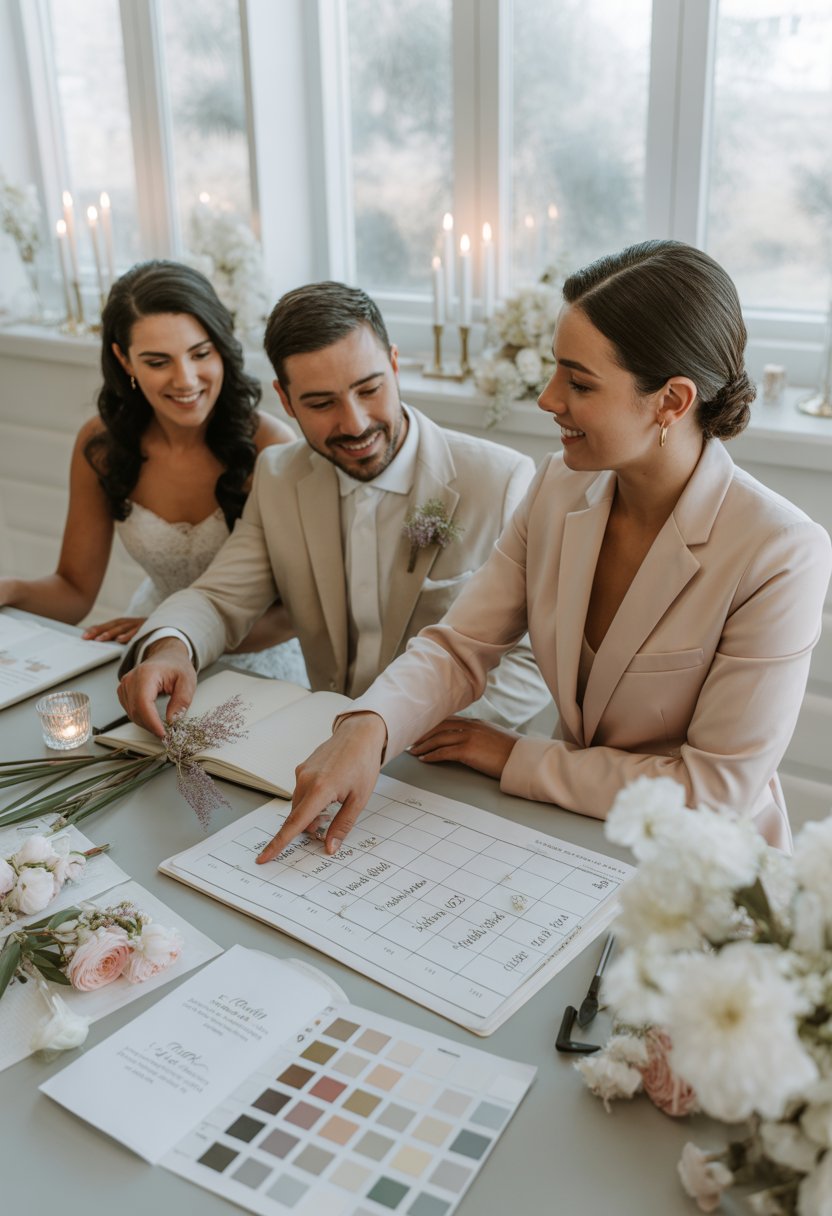
Design and decor is where the numbers climb fastest, and where couples get surprised. A mandap build, floral installations across several rooms, custom lighting, and stage decor for a sangeet can run $15,000 to $60,000 on their own. That sits outside the planner’s fee unless she quoted a bundled design-and-planning package. When you compare quotes, get explicit about which line items live inside the fee and which get billed through outside vendors. Two planners can quote wildly different numbers and both be honest: one is pricing coordination only, the other the whole production. Most couples overspend on florals right here, so itemize before you sign.
Why multi-day celebrations change the pricing math
Labor is the reason. A generalist might budget 120 to 150 hours across a one-day wedding, from first inquiry to load-out. A multicultural wedding planner working a three-event weekend for 350 guests can consume 300 hours or more. The on-site days are brutal: a mehndi running past midnight, a 7 a.m. ceremony call time, a reception that clears at 1 a.m. Nobody works that schedule for the price of a single-day event.
The real hidden cost is coordination between events. Vendors overlap across days, but their schedules do not line up. A caterer might serve three of the four events, each with a different menu. The florist installs, strikes, and reinstalls, sometimes twice in a weekend. A garba needs a completely different DJ setup than a Western reception. Someone has to sequence all of it so nobody double-books the loading dock or the single freight elevator at the same hour.
There is a family-management tax too, and it is real work even if it never appears as a line item. Multicultural weddings often carry two sets of parents with different visions, sometimes different languages, and firm opinions about tradition. The planner becomes the neutral party in the room. She can tell your future mother-in-law that the tea ceremony has to move to 4 p.m. without it turning into a family incident. Couples underrate this until they need it. For a fuller picture of the base scope before the cultural layers get added, our breakdown of full-service wedding planning covers what the standard package includes.
The vendor knowledge you are really paying for
A specialist multicultural wedding planner walks in with a rolodex a generalist has to build from scratch, and it saves you money and headaches in equal measure. She already knows which caterers can genuinely run a halal or kosher kitchen, and which ones will claim they can and then cross-contaminate. Ask about indoor fire ceremonies and she can name the three venues in your metro that allow one. The mandap decorators who show up on time versus the ones who ghost you? She has that list too.
That network also converts into leverage on contracts. A planner who sends a caterer forty bookings a year gets your deposit terms softened and your force-majeure clause read properly. She has watched a decor vendor try to slip in a 50 percent non-refundable deposit. She knows the overtime clause that charges $800 an hour after midnight, which matters when your sangeet is built to run late on purpose. On one 300-guest Sikh wedding, that single relationship turned a $6,000 overtime bill into a waived courtesy hour.

Cultural fluency shows up in small, expensive details. A Nigerian wedding may call for aso ebi coordination across dozens of guests. With a Chinese banquet, the course count is fixed, and serving fewer reads as an insult. A Jewish ceremony needs a chuppah plus four people willing to hold the poles for the entire service. Knowing all of this ahead of time separates a planner who executes your vision from one who learns it on your dime. If you are hiring for a specific tradition, our directory of cultural and fusion wedding planners lets you filter for that exact experience instead of hoping a generalist can improvise.
Questions to ask before you hire a multicultural wedding planner
Generic interview questions will not surface the gaps that matter here. You want to pressure-test actual experience with your specific events, not a vague claim that they love working with diverse couples. Ask for the number of weddings they have run in your tradition over the last two years, and get the names of the venues.
A few questions that separate specialists from generalists:
- How many events have you coordinated across a single wedding weekend, and how many staff did you bring per event?
- Which venues in this area allow an indoor fire or open-flame ceremony, and have you worked in them?
- Walk me through how you would sequence a mehndi, a ceremony, and a reception across two days.
- What goes wrong most often at a multi-day wedding, and how do you prevent it?
- Are your assistant coordinators experienced with this tradition, or just extra hands?
The answers tell you fast whether someone has lived this or is pitching it. A planner who has done it gets specific and a little weary. She remembers the freight elevator that broke and the caterer who showed up ninety minutes late with the ceremony meal. A planner who is bluffing stays abstract. For a broader hiring framework across planner types, our guide to how the matching process works walks through vetting before you sign anything.
When a generalist works, and when it does not
Not every multicultural wedding needs a specialist, and it is worth being honest about that before you pay a premium. Say you are having a single-day event with one primary tradition, a modest guest count, and no complex ritual logistics. A strong generalist who is willing to research and take direction can absolutely pull that off. A Persian sofreh aghd at a 120-person Saturday wedding sits well within a good generalist’s reach, as long as you hand her the details and she actually listens.
The line gets crossed when volume and logistics stack up. Once two or more of these are in play, bring in someone who has done it before:
- two or more events across the weekend
- guest counts above roughly 250
- an indoor fire or open-flame ritual
- a baraat that moves through public streets
- two families with competing visions
The cost of a generalist learning on your wedding is not the fee. It is the missed ritual timing, the venue that says no to the flame three weeks out, and the reception that starts an hour late because nobody built slack into the day.
Destination adds another layer entirely. If your multicultural wedding is also happening abroad, you are combining two hard problems, and the planner needs both skill sets. A destination Hindu wedding in Tulum or Lake Como can add $15,000 to $40,000 just in travel logistics, welcome events, and shipping decor that local vendors cannot source. Our overview of destination wedding planning covers the travel, legal, and vendor-sourcing pieces that sit on top of the cultural coordination. Stacking those two specialties is where fees legitimately reach the top of the range. It is also where trying to save money on the planner usually costs you more somewhere else.
What to budget beyond the planner’s fee
The planner’s fee is a slice of the total, and couples who anchor on it get blindsided by the rest. A realistic multicultural wedding weekend in a major U.S. metro in 2026 runs $80,000 to $250,000 all in, and the planner is 10 to 20 percent of that. The bulk goes to catering across several events, decor and floral installations, and a venue rental for each day. Guest counts also push the total up, because these are family-and-community weddings, not intimate ones. Catering alone often lands at $150 to $300 per head across the weekend, which on 350 guests is a six-figure line before anything else.
Build in a contingency line of 5 to 10 percent, because multi-day weddings generate more surprise costs than single-day ones. Overtime charges, a last-minute rental order when the guest count jumps, a second shuttle when the parking plan falls apart. Here is a common one: the mehndi runs ninety minutes long, the venue’s overtime clause kicks in at $800 an hour, and you suddenly owe $1,200 nobody planned for. A contingency line absorbs that without a 2 a.m. argument over whose family pays. Your planner should flag these before they hit, but the money has to exist in the budget for her to solve them.
When you interview a multicultural wedding planner, ask her to show you a real budget from a past wedding of similar scale, with the names blacked out. The good specialists keep these and will share them. It is the fastest way to see where the money actually goes. You can also sanity-check whether the quote in front of you is complete, or quietly missing $30,000 of decor. Get that document in the first meeting, and you will negotiate everything afterward knowing what things actually cost.