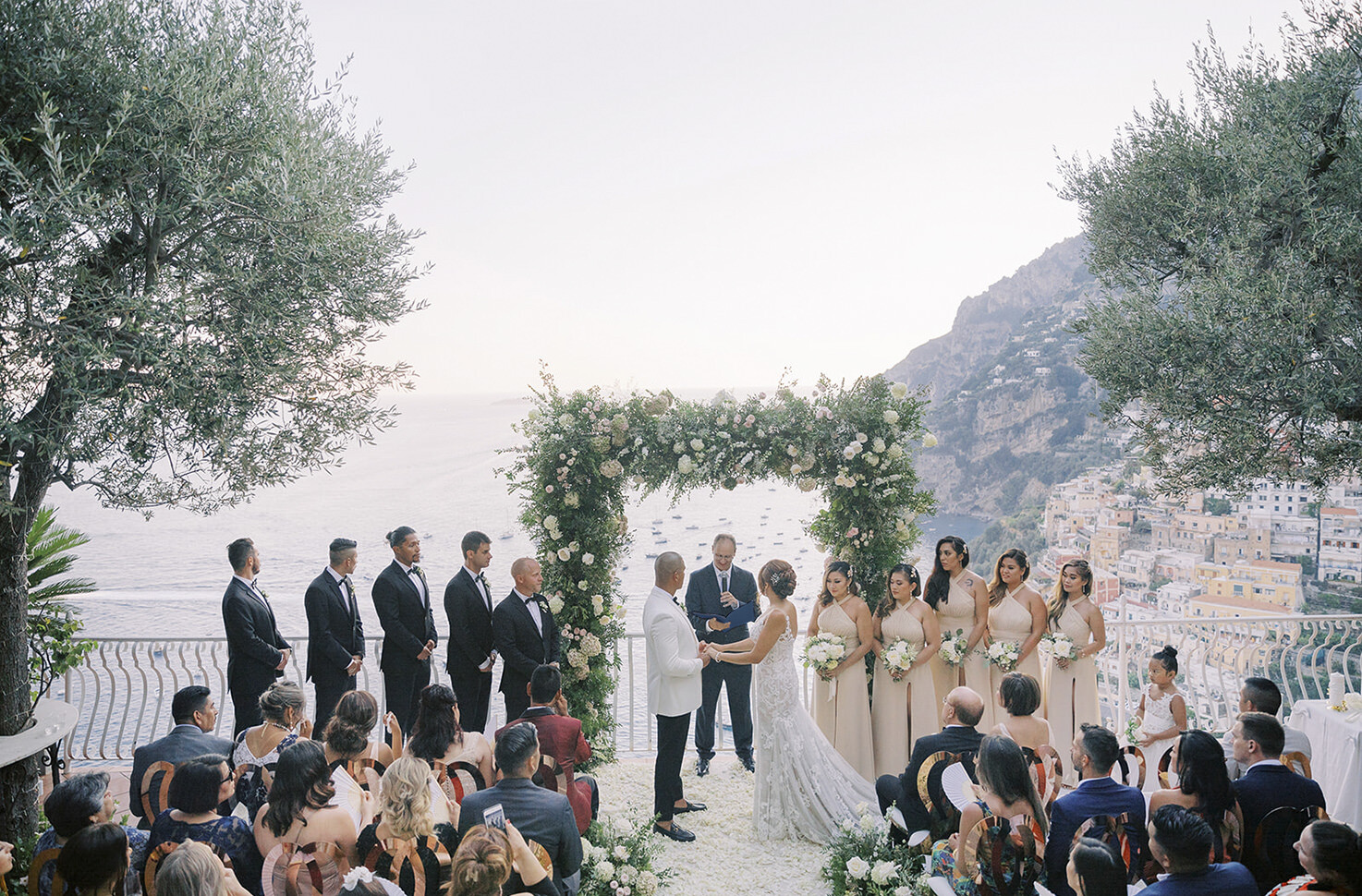
You found a cliffside villa in Puglia. The quote looks reasonable in euros. Then you realize the vendor contracts are all in Italian, the marriage license rules are nothing like home, and you somehow have to feed 80 guests at a property with no in-house catering. That is the moment most couples start asking what a destination wedding planner cost really runs.
The honest answer is wider than most blogs admit. “Destination” covers a $9,000 long weekend in Charleston and a $400,000 three-day event on Lake Como. Below is what destination wedding planner cost actually looks like in 2026. It breaks down by pricing model, real travel costs, and where a local coordinator earns back more than their fee.
What a destination wedding planner cost looks like in 2026
Most destination planners use one of three pricing models, and the model matters more than the headline number. Flat-fee planners in the US and nearby spots like Mexico and the Caribbean usually run $4,500 to $12,000 for full-service planning of a 60-to-100-guest wedding. Percentage-based planners, common at the luxury end and across Europe, charge 12% to 18% of total spend. On a $150,000 wedding, that lands at $18,000 to $27,000.
The third model is a hybrid. A base fee around $6,000 sits underneath a smaller percentage on top. That structure protects the planner if your budget balloons after you fall for a band that flies in from Miami. Most couples I talk to underestimate how often that happens, and it is exactly how a destination wedding planner cost creeps past the first estimate.
Geography moves these numbers hard. A planner working Tuscany, Santorini, or the Amalfi Coast quotes higher than one working Tulum or Punta Cana. European vendor markups and permitting are steeper, the planner pool is smaller, and the best ones book out 18 months ahead. The Knot’s reporting on average wedding costs shows the gap between a domestic celebration and one abroad keeps widening.
If you are comparing quotes, compare the same service tier. A full-service planner is not the same as someone offering month-of coordination with a fancier title. That mismatch is the most common reason a destination wedding planner cost looks cheap on paper and balloons by the rehearsal.

One number to anchor on. Across the planners in our destination wedding planner directory, full-service fees cluster between $7,000 and $15,000 for a mid-range international wedding, before travel. Treat anything dramatically under that with curiosity, not suspicion. It usually signals a narrower scope, not a bargain.
Flat fee vs percentage: which actually saves you money
The pricing model you choose changes everyone’s incentives, yours and the planner’s. A flat fee is predictable. You know on day one that planning costs $9,000 whether your final budget lands at $80,000 or $130,000. Couples on a fixed budget sleep better this way, and so do planners who are confident about scope. The risk sits with the planner. If your wedding turns into three pre-events and a logistical monster, they eat the extra hours.
Percentage pricing flips that. At 15% of spend, the planner earns more as you spend more. That sounds like a conflict until you remember the job. A good planner at that tier talks you out of the $14,000 floral install nobody remembers after cocktail hour. Percentage makes sense when your budget is genuinely uncertain. You want the planner inside every vendor negotiation, and the total is large enough that a flat fee feels arbitrary. On a $300,000 wedding, a 12% fee is honest pay for a year of work.
Here is the test I give couples:
- Budget under about $120,000 and reasonably defined: push for a flat fee, or a hybrid with a low percentage cap.
- Budget north of that and still moving: percentage often beats the padded flat quote built to cover the unknown.
- Planner quotes only one structure: treat it as a flag and ask for it priced both ways.
A planner who refuses to quote both ways may not be the most flexible partner for a complicated international build. The split between full-service and partial planning packages shifts the math too, since partial scope rarely justifies a percentage at all. A destination wedding planner cost can quietly double here if you let the structure go unquestioned.
The travel costs nobody puts on the first quote
Destination budgets quietly leak right here. Your planner’s fee covers their expertise and hours. Their travel to your destination is almost always billed on top, and the first proposal often buries it or leaves it off. Expect to cover round-trip airfare and lodging for the planner, frequently one assistant too. Add ground transport and a per-diem for meals during site visits and the wedding week.
For a European wedding planned from the US, planner travel can add $3,000 to $8,000. That covers the scouting trip plus the wedding-week stay. Some planners fold a single site visit into the fee and bill extra trips at cost. Others charge for every trip. A handful of US-based specialists do not travel at all. They partner with a local coordinator instead, which runs cheaper but adds a layer to manage.
Three line items I tell couples to get in writing before signing:
- How many in-person site visits are included, and what each extra visit costs.
- Whether an assistant’s travel and lodging are billed, and at what hotel tier.
- The per-diem rate, and whether it applies to scouting trips or only the wedding week.
Nail those down and your destination wedding planner cost stops surprising you in month seven. Leave them vague and a $9,000 fee quietly becomes $15,000 by the time everyone has flown home. I watched one couple lose their whole contingency fund to two unbudgeted site visits. Nobody had flagged the assistant’s flights either.

When a local on-site coordinator pays for itself
There is a real difference between two roles. One planner designs and runs your wedding from afar. A local coordinator lives in the destination and knows every vendor by name. Many couples need both. The smartest budgets pair them on purpose, even when it nudges the destination wedding planner cost up at the start.
A local coordinator runs $2,500 to $6,000 in most international destinations. They earn it in ways that never appear as a line item. They know which villa has a noise ordinance that kills the music at 11pm. They have the cell number of the one reliable florist within an hour’s drive. At the permit office, they speak the language. And they know the “included” venue catering in Mexico often leaves off the 16% IVA tax. That tax lands on your final invoice. A planner working from New York misses all of that. The cost of missing it shows up as stress and last-minute premiums.
The pairing I see work best is simple. A full-service planner owns design, guest experience, and the master timeline. A local coordinator executes on the ground and manages regional vendors. Yes, you pay two professionals. But on a $120,000 destination wedding, an extra $4,000 on local knowledge routinely pays for itself. It comes back in dodged vendor markups and currency mistakes. If your destination is somewhere you have never set foot, do not skip the local to save money. Our guide on how the matching process works covers how planners and local partners usually split the work. That split shapes your overall cost more than the headline fee suggests.
What is included, and what quietly is not
A destination wedding planner cost only means something next to a scope of work. Two planners quoting $8,000 can deliver wildly different things. Read the proposal for what it promises across the whole planning year, not just the wedding weekend. Full-service destination planning usually covers:
- Venue sourcing, full vendor selection, and contracting.
- Budget management, design direction, and styling.
- Guest logistics, including room blocks and welcome details.
- The master production timeline and on-site management for the wedding day, plus a welcome event.
What gets left out is worth asking about directly. Legal marriage paperwork and translation, guest travel booking, labor-intensive room-block negotiation, rehearsal dinner and farewell brunch coordination, and any design fabrication beyond sourcing all tend to fall outside the base fee. I have seen a $2,000 surprise land on one couple. Translating and notarizing their paperwork was billed as an add-on nobody mentioned.
The legal piece trips couples up constantly. A legally binding wedding in France requires one spouse to establish 40 days of residency. That is why most couples marry legally at home first and hold a symbolic ceremony abroad. A good planner tells you this on the first call. Marriage licenses, apostilles, and certified translations are real work. Whether your planner handles them or hands you a checklist changes the value of the fee.
Ask for the proposal to list inclusions and explicit exclusions side by side. If a planner cannot produce that, they have not run enough of these to know where the gaps bite. The ones worth hiring keep a standard scope document, because the ambiguity has burned them before.
Deposits, payment schedules, and the cancellation clause that matters
Destination planners structure payments around a long engagement and heavy upfront vendor commitments. A destination wedding planner cost is rarely paid in one lump. A common schedule is 30% to 50% on signing. The balance splits across two or three milestone payments, with the last due 30 to 60 days out. Percentage-based planners often bill a deposit against an estimated total, then true up once the real budget firms.
The clause to read twice is cancellation and force majeure. After several years of weddings derailed by travel shutdowns, storms, and political unrest, the planner’s deposit is almost always nonrefundable. That is fair. They have done real work and turned away other dates. What you want to confirm is the postponement provision.
Does the planner roll your deposit to a new date inside 12 or 18 months without a rebooking fee? What happens to vendor deposits already paid in your name if a hurricane shuts your destination the week of the wedding? Those vendor deposits are usually the bigger exposure, not the planner’s fee. Read that section before you read the price.

Good travel insurance with a cancel-for-any-reason rider runs roughly 7% to 12% of your insured spend. I tell every destination couple to budget for it as a real line item. If your planner never raises insurance on their own, treat it as a small but telling signal. It says a lot about how carefully they think about what goes wrong. At the top of the market, the luxury planning tier usually builds contingency and insurance coordination into the fee. That is part of what the higher slice of your destination wedding planner cost actually buys.
How to compare quotes without getting fooled
When three proposals land at $6,500, $9,000, and $14,000, the instinct is to call the middle one safest. Resist that. Normalize the quotes first. Put planner fee, travel, assistant cost, number of site visits, and the local-coordinator arrangement into the same row for each. The real spread usually narrows, or flips. The $6,500 planner who bills every trip and brings two assistants can land above the $9,000 one. That planner includes a single visit and partners with a local.
Then weight experience in your specific destination. A planner who has run 15 weddings in Oaxaca beats a generalist with 60 domestic weddings and one in Mexico. The value sits in the regional relationships and the mistakes they already made on someone else’s budget. Ask how many events they have produced in your exact region in the last two years. Ask for two references from couples who married there. Vague answers should end the conversation.
Last, judge responsiveness during the proposal stage, because that is the most attentive a planner will ever be. If replies take a week now, picture that lag when a vendor goes silent 30 days out. Start by browsing destination wedding specialists who already list their regions. Then ask each for a normalized quote and one reference in your exact destination. The planner who answers both cleanly is usually the one whose destination wedding planner cost is worth paying.